Bhubaneswar clinics should price written plans, not visits, and explain how pricing works on their website, because many patients research before calling. Charge for consultations, give three honest options with one recommendation, quote the same fee to everyone, print EMI and milestone payments next to the total, and offer formal corporate tie-ups instead of ad hoc discounts.
A Bhubaneswar patient often knows a lot before she calls. She has read your website and two competitors' websites, compared Google reviews, watched a video or two and asked a colleague in the next cubicle. Then she messages: "Approx kitna hoga?" or, if it is her father calling from Cuttack, "Kete tanka lagiba?" How much will it cost? The way you answer, online and on the phone, decides whether she books with you or keeps comparing.
Why does pricing transparency matter so much in Bhubaneswar?
Because researchers trust the clinic that explains. You do not have to print every fee. But a clear page on how pricing works, what is included in a plan, what changes the cost and which payment options you offer builds trust before the first call. It also filters out people who were never going to fit your position.
Families from across Odisha have a second comparison in mind: the cost of travelling out of state for treatment. Never criticise another centre. Just help them compare honestly, including travel for the patient and an attendant, stay, days off work and repeat trips for follow-up.
How should you price the consultation?
Charge a clear fee. In a city where many patients have already read about you, a paid consultation confirms that they are getting a specialist's full attention, not a sales chat. You can credit it against the plan if they go ahead.
Before setting fees, mystery-shop the ten options your patient compares you with: other clinics in Bhubaneswar and Cuttack, large hospitals, chains and the out-of-state option. Note how they reply, quote and follow up. Then pick a position: premium, niche specialist or volume. Never the middle, where nobody remembers you.
What does a plan look like instead of a price per session?
Price the outcome. Here is how three honest options might look for a back pain programme at a physiotherapy and rehab clinic, a common need among people who sit at desks all day:
| Basic | Recommended | Complete | |
|---|---|---|---|
| Programme | A short block of sessions for pain relief | The full programme the physiotherapist advises for this patient | The full programme |
| Home plan | A printed exercise sheet | A personal home exercise plan with video guidance | The same, with progress checks on WhatsApp |
| Reviews | One review | Reviews at the end and one month later | Monthly reviews for three months, plus a workstation check |
| Best for | A tight budget | Getting better and staying better | The fullest support |
Each option must be genuine and safe, and they must differ in outcome. Present the assessment first, then the goal, then the options from Complete down to Basic, then your recommendation, and the price last. Say the number, then stop talking.
When you price per session, every session becomes a new decision and many patients stop halfway, then decide physiotherapy "did not work". When you price the plan, they decide once.
How do you make a big fee feel manageable?
A young couple in Patia will compare the total with their monthly salaries, so do that maths for them. Here is an example: a fertility treatment plan of ₹2,10,000 spread over 12 months is ₹17,500 a month. Print both figures, side by side, on the written plan, right under the fee.
Offer, as normal options for everyone:
- Full payment.
- Milestone payments across the phases of the plan.
- EMI through two or three lending partners.
- Credit card EMI.
- Insurance, where the treatment is covered and you are empanelled, with a trained person handling the paperwork.
Explain the full cost of any financing, never push a loan and never use financing to sell a bigger plan than the patient needs. No-cost EMI is never free, because someone pays the lender's fee, usually you, so build it into your pricing.
What do you say when someone asks for a "corporate discount"?
In a city with many IT companies and offices, you will hear it often: "Any discount for employees?" Do not improvise a cut at the counter. Instead, decide your answer once.
If you want to work with employers, set up formal corporate tie-ups: a written arrangement with an organisation, often starting with a health talk for its staff, that may include agreed services, a dedicated contact or help with insurance paperwork. Make it the same for everyone at that company, in writing.
For individual patients, give the team one calm sentence to use in Odia, Hindi or English, something like: "Every patient pays the same fee here, but if the budget is tight, we can choose a different plan or split the payment."
Here is why ad hoc discounts hurt. Say a plan is ₹40,000 and costs you ₹14,000 to deliver, leaving ₹26,000. A 20% discount brings the price to ₹32,000 and your profit to ₹18,000. You now need about 1.44 times as many patients just to earn the same. And everyone who paid full price feels cheated when colleagues compare notes.
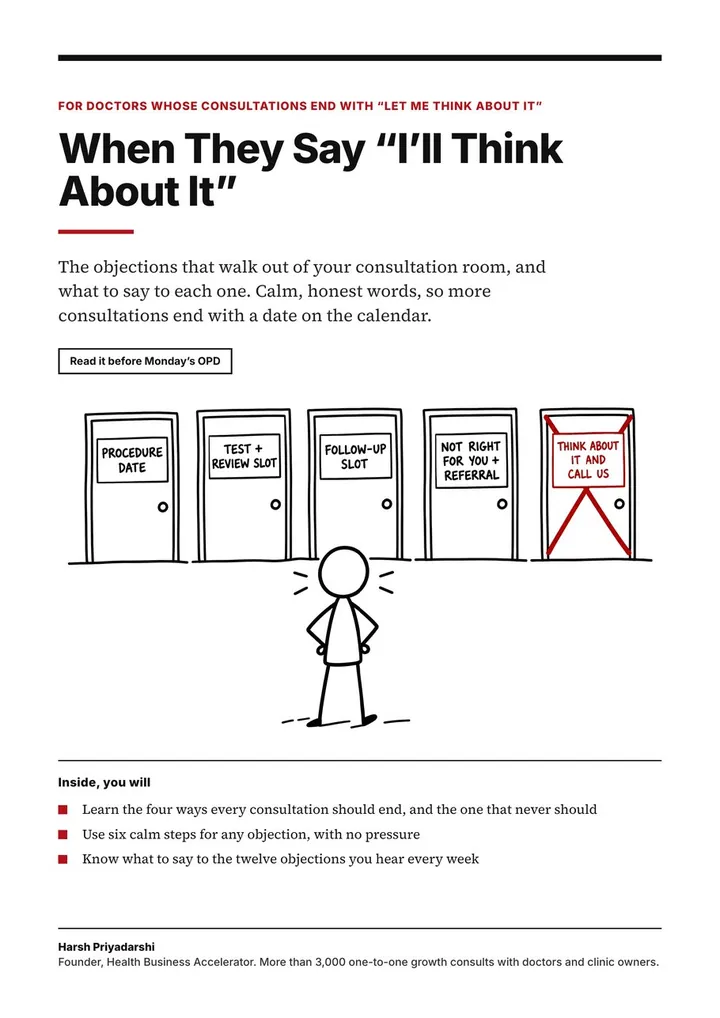
If a patient still hesitates, you have four honest options: offer a smaller plan, offer a different way to pay, remind them of the outcome they said they wanted, or accept that this patient is not yours. Lowering the fee is not one of them.
Who should talk about fees with the patient?
Ideally not the doctor. Once you have recommended a plan, hand over by name to a coordinator or a trained front desk person: "Ananya will take you through the plan and the payment options." They sit with the patient, and with the family on a call if needed, go through the written plan slowly, answer the questions people are too shy to ask the doctor, and book the next step. For many Odia families, this unhurried conversation in their own language is where the decision is actually made. The doctor's role stays clinical.
How often should Bhubaneswar fees go up?
Once a year, on one fixed date. Raise for new patients first, honour every existing plan and written quote, and pair the rise with something new, such as better aftercare. If your consult conversion stays above 50% for a quarter or patients wait weeks for a slot, you are probably underpriced. Our conversion systems work covers pricing and the conversation around it, and the full method is in Good Doctors Go Broke. More on practices here is on our Bhubaneswar page.
The short version
- Explain how pricing works on your website, because Bhubaneswar patients research first.
- Charge for consultations, and pick premium, niche or volume, never the middle.
- Price written plans with three honest options and one recommendation.
- Print EMI and milestones next to the fee, and build any no-cost EMI into your price.
- Offer formal corporate tie-ups, never ad hoc discounts.
Frequently asked questions
Should Bhubaneswar clinics publish their prices online?
Explain how pricing works, even if you do not list every fee. Say what a plan includes, what changes the cost and which payment options you offer. Research-minded patients trust clinics that are open, and the explanation filters out people who would never fit your position.
How do I handle patients who compare my fees with other clinics?
Help them compare properly, on outcomes, what is included and the care around the treatment, not just the headline number. Give an honest range on the phone, invite them for a diagnosis and present a written plan with three options. Never cut your fee to match.
Can my clinic offer special rates to IT company employees?
If you want to, do it through a formal written tie-up with the employer, applied the same way to everyone there, often alongside health talks or insurance help. Avoid ad hoc discounts at the counter, which undermine your fee sheet. Check the arrangement with your chartered accountant.
Is it better to charge per session or per plan for physiotherapy?
Price the plan. Per-session pricing turns every visit into a new decision, and many patients stop before they improve. A written programme with a clear goal, three options and a payment schedule helps patients commit, finish and get the result they came for.
On a free growth call, my team traces your last month from enquiry to treatment and shows you your biggest leak in rupees.