Pune clinics should hire front desk staff for warmth, persistence and fluency in at least two of Marathi, Hindi and English, tested with a phone call and a role-play, not a CV. Pay a fair salary plus an incentive on patients who show up. Add a treatment coordinator once you pass twenty consultations a day, hire them for calm money conversations, and train both properly.
A Pune clinic owner once told me he had hired four receptionists in a year. "Good English, smart, well presented," he said. "And every one of them left within months." When we listened to their calls, the pattern was obvious. They read out information well. They never asked a single question, never offered a slot, and struggled when an older patient spoke in Marathi.
He had hired for the wrong things. Here is how I would hire and train front desk staff and treatment coordinators for a clinic in Pune.
Why is hiring clinic staff hard in Pune?
Three reasons come up again and again.
Competition for good communicators. Pune has a large service sector, and people who are warm and clear on the phone have plenty of options. A clinic offering an unclear role, no training and no growth path loses them.
Commute. A long daily journey across the city wears people down. Someone who lives within an easy commute of your clinic is far more likely to stay and to arrive on time for the evening rush.
Language. Your patients speak Marathi, Hindi and English. Hiring only for polished English leaves many of your callers struggling to be understood.
What should a Pune clinic hire its front desk for?
Not good English, a nice appearance and a low salary. Hire for:
- Warmth you can hear in a voice.
- Empathy for people who are anxious or in pain.
- Persistence to keep following up without sounding pushy.
- Fluency in at least two of your patients' languages, and comfort switching between them.
Test for those directly.
- The phone test. Before any interview, call the candidate and have a short chat. That is exactly how your patients will meet them.
- The language check. Switch to Marathi or Hindi halfway through, and see how naturally they follow.
- The role-play. You play a worried patient who wants the price. The best candidates ask questions and try to help. The worst read out information.
- The shadow day. Let your top candidate spend a day at the desk before you decide.
Good places to look: people with customer-facing or voice-process experience, hospitality and airline staff, and your own existing team.
When does a Pune clinic need a treatment coordinator?
Once you pass about twenty consultations a day. Below that, the doctor and a well-trained front desk can share the job. Above it, patients walk out undecided every day and nobody follows up.
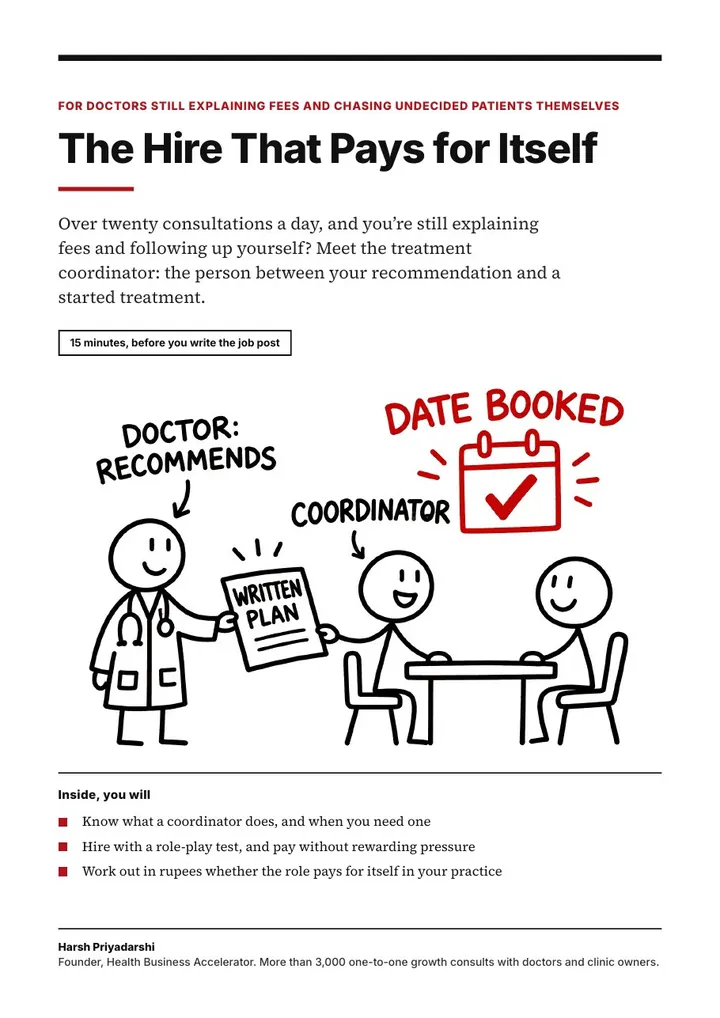
The coordinator is the bridge between the doctor's recommendation and the patient's decision. They walk the patient through the written plan, explain the options, fees and EMI, help with insurance paperwork where it applies, talk to the family and book the next step.
Hire them for warmth first, then calm confidence about money, clear explaining, listening and follow-up discipline. Nurses who are great with patients often make excellent coordinators, as do people from hospitality, banking and insurance sales. Test with this role-play: you loved the doctor, but the fee is more than you expected and you need to ask your husband.
A coordinator negotiates the plan, never the price.
What mistakes do Pune clinics make when hiring?
The same four, again and again.
- One person for everything. The receptionist also handles walk-ins, billing and the pharmacy, and is then expected to call every new enquiry within minutes. Nobody can. Give new enquiries a dedicated person or line.
- Hiring a friend of a friend without a test. A pleasant manner in person tells you nothing about how someone sounds on the phone at 7.30 pm.
- No evening cover. The busiest enquiry hours are left to whoever is still around.
- Training for a day. Then wondering why the calls don't follow the script.
How should you pay front desk staff and coordinators?
| Role | Fixed part | Incentive on | Guardrails |
|---|---|---|---|
| Front desk | A fair fixed salary | Patients who book and actually show up | Never pay on bookings alone |
| Treatment coordinator | A fair fixed salary | Treatments actually started | Track refunds and complaints, review conversations weekly, never reward pressure |
Paying on show-ups rather than bookings stops people booking anyone just to hit a number. And a coordinator who pushes patients into plans they regret costs you far more in reputation than any target they hit.
How should a Pune clinic train new staff?
The front desk's first week: your niche, your doctor, your plans and fee sheet, your scripts in all three languages, and your CRM. They listen to recorded calls, good and bad, and practise role-plays until the five-step call comes naturally.
The coordinator's first four weeks:
- Learn everything the doctor knows about your core treatments, at a patient's level.
- Sit in on consultations, and watch procedures where possible.
- Learn the three options, the fee sheet and every payment option inside out.
- Practise objection handling until it feels natural.
- Learn the follow-up cadence: same day, next day, then day three, seven and fourteen.
After that, training never stops. Record calls with the caller's knowledge, score three a week out of five, and celebrate great calls in front of the team. A knowledge assistant built on your SOPs and scripts can help new people find your clinic's answer quickly while they learn. This is the work of our team training.
What should each role own?
Give every person a one-page role card: what they own, the numbers they are measured on, and what a great week looks like.
- Front desk: answer rate, speed to first contact, booking rate and show rate.
- Coordinator: share of consultations that start treatment, time to decide, average plan value, option split, and undecided patients brought back.
People stay where they can see how their work turns into results. Show them the numbers every Monday, and give them a path: front desk lead, coordinator, then practice manager. The conversion side of this is covered in our front desk and conversion work, and the full method is in Good Doctors Go Broke.
The short version
- Hire for warmth, persistence and language, not just polished English.
- Test with a phone call, a language switch and a role-play.
- Add a coordinator past twenty consultations a day.
- Pay on show-ups and started treatments, with guardrails against pressure.
- Train in week one, then review calls every week. More for Pune clinics is on our Pune page.
Frequently asked questions
How much should a clinic in Pune pay its front desk staff?
Pay a fair fixed salary for your area and the skills you need, plus an incentive for patients who book and actually show up. Check what similar customer-facing roles pay nearby, because good communicators in Pune have options. Underpaying the person who handles every enquiry usually costs far more in lost patients than it saves.
Should my Pune clinic's receptionist speak Marathi?
If many of your patients or their parents are more comfortable in Marathi, yes. A front desk fluent in Marathi, Hindi and English covers most Pune callers. If one person can't do all three, plan shifts so every language is covered, and keep WhatsApp templates ready in each. Language fit lifts booking rate quietly.
When does a clinic need a treatment coordinator?
In my framework, once you are doing more than twenty consultations a day. Below that, the doctor and a well-trained front desk can share the work with a clear handover. Above it, undecided patients leave without follow-up every day, and a dedicated coordinator usually pays for themselves through treatments that actually start.
How do I stop good clinic staff from leaving?
Hire people who live within an easy commute, give them proper training, show them their numbers every week, and celebrate good calls publicly. Pay a fair salary with an incentive they can actually earn, and offer a clear path from front desk to coordinator to manager. People leave unclear roles far more often than demanding ones.
On a free growth call, my team traces your last month from enquiry to treatment and shows you your biggest leak in rupees.