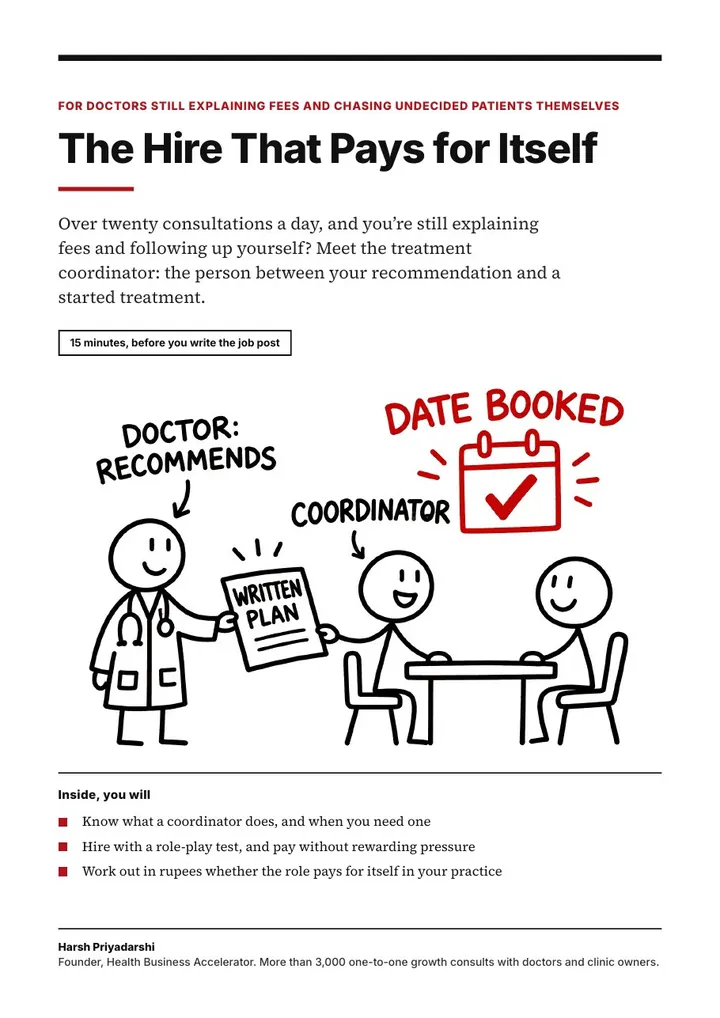
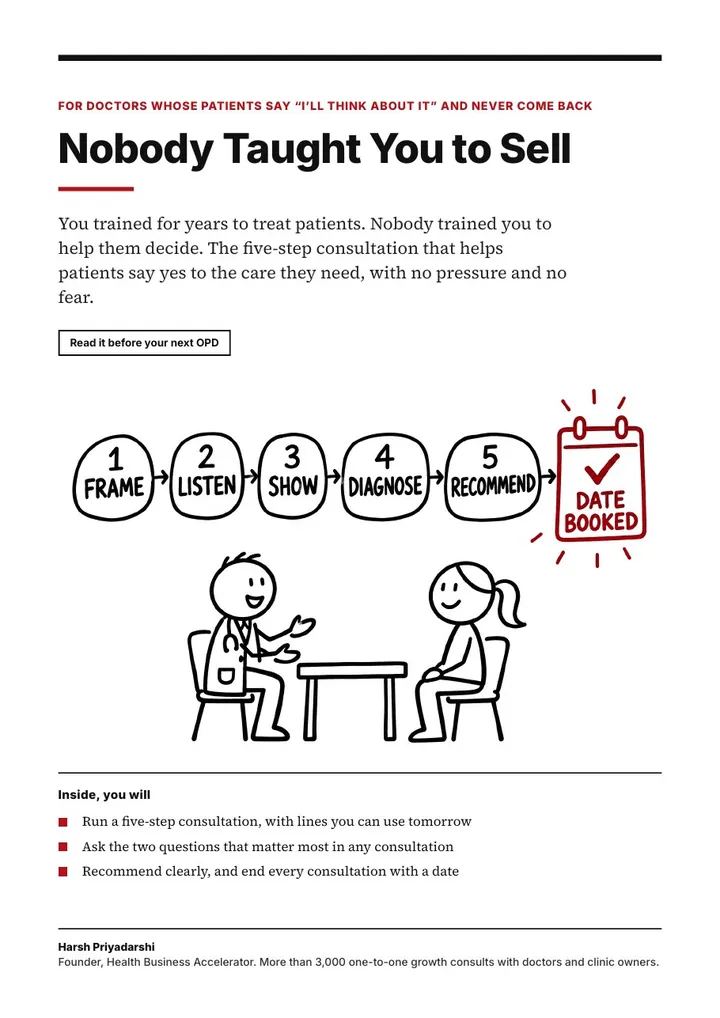
Kochi clinics should hire front desk staff and treatment coordinators for warmth, patience with detailed questions, persistence and natural Malayalam and English. Nurses who want to move out of clinical work often make excellent coordinators. Test every candidate with a phone call and role-plays of an informed patient and a family member in the Gulf, pay a fair salary plus an incentive on show-ups or started treatments, and train properly.
A Kochi clinic I know had a coordinator problem for a year. They had tried two people from sales backgrounds. Both were confident and quick, and both made patients uneasy. Then the doctor noticed that one of the clinic's own nurses was the person patients always asked for. She explained things slowly, she remembered every family's story, and she never looked rushed. They trained her for the coordinator role. Within a few months, more consultations were turning into treatments than ever before, and fewer patients went home to "think about it".
Kerala trains a great many nurses, and many of them are exactly the kind of person a coordinator role needs. That is one of Kochi's quiet advantages, if you know to look for it.
Which roles does your clinic need?
At ₹3 to 15 lakh a month, the key hire is one front desk person who can convert leads. Between ₹15 and 50 lakh a month, roles need to split:
| Role | What they own | What they are measured on |
|---|---|---|
| Enquiry handler | Every call and WhatsApp, to a confirmed visit | Answer rate, speed to first contact, booking rate, show rate |
| Treatment coordinator | From the doctor's recommendation to a paid, started treatment, plus follow-ups | Consultations that become treatments, time to decide, average plan value, undecided patients brought back |
| Practice manager | The daily running of the clinic and team | SOPs followed, Monday numbers ready, issues solved |
Once you pass about twenty consultations a day, a dedicated coordinator stops being optional. Below that, the doctor and a well-trained front desk can share the job.
What should you hire for in Kochi?
For both roles: warmth, patience, persistence and natural Malayalam and English. Add one thing Kochi patients test every day: patience with detailed questions. Many patients here read about their condition and ask thoughtful questions. A front desk person who gets flustered or defensive will lose them. One who says "that's a good question, let me note it for doctor" keeps them.
Coordinators need more: calm when money comes up, plans explained simply, more listening than talking, and follow-up without being chased. They will often speak to a patient in the room and a son or daughter in the Gulf on a video call at the same time.
Where do you find good people?
- Nurses who are good with patients and want to move away from clinical shifts. They understand the medicine and the fear.
- Patient relations and counselling staff at Kochi hospitals.
- Hospitality, banking and insurance, where people learn to handle anxious customers and money conversations.
- Your own team, especially whoever patients already ask for by name.
- Referrals from staff and colleagues, and job portals.
How do you test them?
- The phone test. Call before the interview and talk for five minutes, partly in Malayalam, partly in English.
- The informed patient role-play. You are a patient who has read about her condition and asks, "I read that this procedure has a long recovery. Is that true here? And why is your package more than the hospital near my house?" Watch whether they stay calm, avoid medical advice, note the clinical question for the doctor, explain how the plan is priced and move gently to booking.
- The Gulf family role-play for coordinators. You are a son in Dubai on a video call: "I'm paying for this. Can you tell me exactly what is included, and what happens if Amma needs extra sessions?" Watch how clearly they walk through the written plan and payment options.
- A shadow day in the clinic before you decide.
How should you pay them?
A fair fixed salary plus an incentive on the right number. The front desk earns it on patients who book and then actually arrive. For the coordinator, on treatments started.
Add guardrails: never reward pressure, track refund requests and complaints, and review a sample of conversations every week. In a city where patients compare notes and talk to each other, a coordinator who pushes is a reputation risk.
How do you train them properly?
Front desk, first two weeks: your niche and doctor at a patient's level, the fee sheet, the five-step call in Malayalam and English, WhatsApp templates in both, confirmations with directions and traffic notes, and daily role-plays.
Coordinator, first four weeks: everything the doctor knows about your core treatments, at a patient's level, because Kochi patients will ask; sitting in on consultations; the three options and every payment option, including payment links for family abroad; objection handling; and the follow-up process in your CRM.
An approved answer bank. Write down the twenty to forty questions patients ask most, with the doctor's approved, simple answers. Keep it in one place where the team can search it. Some clinics now build a simple knowledge assistant on top of it, so a new front desk person can find the approved answer in seconds. Keep it to approved information only, and anything clinical always goes to the doctor.
What keeps the team sharp?
A ten-minute huddle before the first patient: today's appointments, anxious patients, families abroad expecting a call, and yesterday's leads still to contact. A weekly call review, scoring three recorded calls out of five together. Then, every Monday, the four front door numbers: answer rate, speed to first contact, booking rate, show rate.
Our team training runs the hiring tests, role-plays and call reviews, and our CRM and AI work can set up the answer bank and knowledge assistant safely. The full method is in Good Doctors Go Broke. See how we work with clinics in Kochi.
The short version
- Hire for warmth, patience with detailed questions, persistence, and natural Malayalam and English.
- Look at nurses who want to move out of clinical work. Many make outstanding coordinators.
- Test with a phone call, an informed patient role-play and a Gulf family role-play.
- Reward arrivals and started treatments, and watch closely for pressure.
- Give the team an approved answer bank, and keep anything clinical with the doctor.
Frequently asked questions
Can a nurse become a good treatment coordinator?
Often, yes. Nurses who are good with patients understand both the medicine and the fear, and patients trust them quickly. Train them on your plans, the three options, payment and EMI options, objection handling and your follow-up process. Make sure they want the role, and keep clinical decisions with the doctor.
How do I train front desk staff to handle detailed patient questions?
Write an approved answer bank of the questions patients ask most, with simple answers the doctor has signed off. Train staff to answer general questions from it, note anything clinical for the doctor, and move to booking. Role-play informed patients every week until staff stay calm and helpful under detailed questions.
What should a treatment coordinator be paid on?
A fair fixed salary plus an incentive on treatments actually started, not consultations booked. Add guardrails so the incentive never rewards pressure: track refund requests and complaints, review a sample of conversations every week, and step in quickly if any patient feels pushed into a plan.
When should a clinic hire a practice manager?
Usually somewhere between ₹15 and 50 lakh a month, when the doctor has become the bottleneck and the team has grown into separate roles. Starting part-time is fine. The practice manager owns the daily running of the clinic, the SOPs and the Monday numbers, freeing the doctor to lead.
On a free growth call, my team traces your last month from enquiry to treatment and shows you your biggest leak in rupees.