In Kanpur, price the plan that gets the result, not the visit or the session. Charge a clear consultation fee, then give three honest options, Basic, Recommended and Complete, recommend one, and show the EMI figure next to the total. When patients ask for a discount, change the plan or the payment schedule, never the price, and quote from one written fee sheet.
"Doctor sahab, thoda kam kar dijiye." If you practise in Kanpur, you have heard it this week. Probably today. It is a trading city, and bargaining is how many people show respect for their own money, not disrespect for you. The mistake is treating it as a price problem. In the clinics we have worked with across India, the ones that cut prices to close patients ended up with thinner margins, more bargaining and patients who trusted them less, and a bargaining city only speeds that up.
Why do Kanpur patients price-shop so hard?
Three patterns show up again and again.
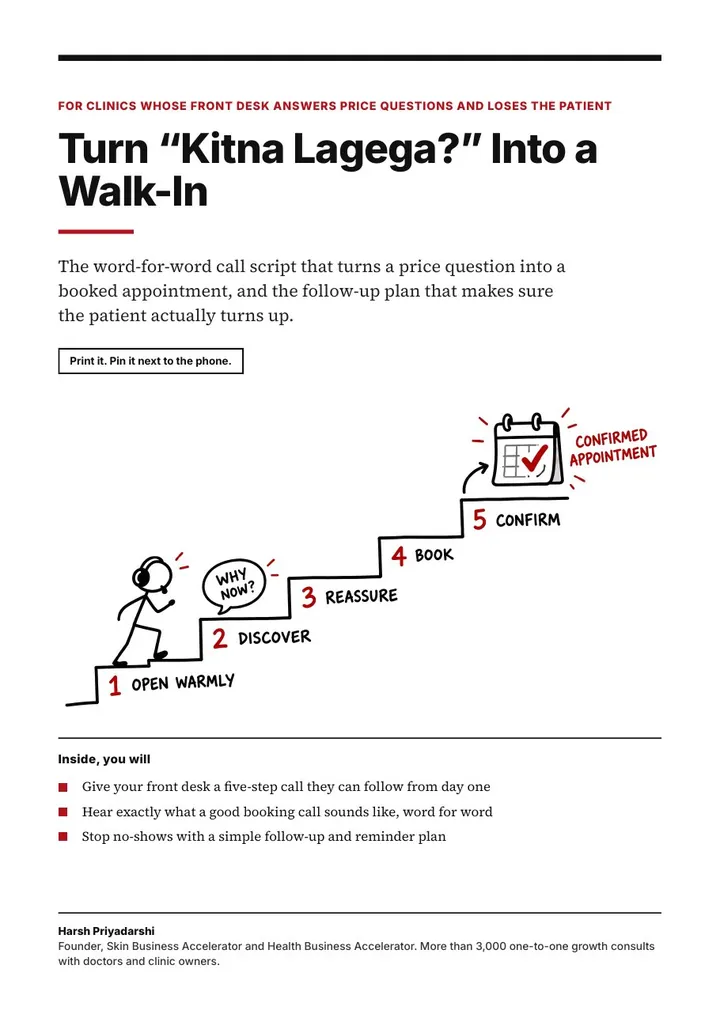
They call around. Many patients ring five clinics, ask "kitna lagega?", and choose the lowest number. If your front desk gives a bare number, you have joined a price list.
They compare across cities. For bigger procedures, a family may weigh a clinic in Kanpur against one in Lucknow or Delhi, often based on prices heard from relatives.
The decision maker is not in the room. The patient goes home with a number, and someone who never met you decides it is too much.
You cannot change any of this. You can change what you price and how you present it.
There is one more Kanpur habit worth naming: the "known person" discount. A patient arrives saying a relative works with someone you know, and expects a lower fee. If you give it once, the story spreads, and soon half your patients are known people. Decide now that the fee sheet is the same for everyone, and that you show respect through time, attention and follow-up, not a lower number. Your front desk will find that line much easier to hold if they know you will hold it too.
How do I price the plan instead of the visit?
When you price per visit or per session, every visit becomes a new buying decision. Patients drop out halfway, get half a result and blame you. Price the plan that gets the outcome instead:
- Start from the outcome. What will the patient have at the end?
- Write down every step, including the ones patients usually get billed for separately.
- Put dates on it, so the family knows when to expect results.
- Include the follow-ups and aftercare.
- Price the whole plan as one number.
- Offer a simple payment schedule, by milestone or EMI.
How should three options look for a Kanpur patient?
One price makes the patient think "yes or no?". Three options make them think "which one?". Here is an example for a knee replacement, with made-up prices to show the structure.
| Basic | Recommended | Complete | |
|---|---|---|---|
| Surgery | One knee, standard implant | One knee, implant chosen for the patient's activity | One knee, premium implant |
| Physiotherapy | Hospital stay only | Six weeks included | Twelve weeks, including home visits |
| Reviews | One review | Reviews at 6 weeks, 3 and 12 months | Reviews for two years |
| Example price | ₹1,60,000 | ₹2,10,000 | ₹2,60,000 |
| Example EMI over 12 months | ₹13,333 | ₹17,500 | ₹21,667 |
Every option must be honest and safe. Present the diagnosis first, then the outcome, then the options from Complete down to Basic, then your recommendation, and the price last. And always recommend one: "Based on what I've seen in your X-ray, I recommend this one, and here's why."
Notice what the EMI row does. The gap between Basic and Recommended is ₹50,000 as a total, but about ₹4,167 a month. For a family from Fatehpur or Unnao weighing the decision at home, that difference is much easier to picture.
What should the consultation fee be?
Charge for the consultation. A paid consultation tells patients your time has value, and it filters in the serious ones. Some doctors credit the consultation fee against the plan if the patient goes ahead, which is a fair way to soften it. Your front desk should state it plainly on the phone, with a short explanation of what the consultation includes: time with the specialist, an examination and a written plan.
If a patient says another clinic offers a free consultation, do not argue. Explain calmly what your consultation includes and let them choose.
What do I say when a patient asks for a discount?
Give everyone the same line, written down, in Hindi and English. For example:
"Hamari fees sab patients ke liye ek jaisi hai. Agar budget ki chinta hai, toh hum doosra plan dekh sakte hain, ya payment ko mahino mein baant sakte hain." Our fees are the same for every patient. If budget is a concern, we can look at another plan or spread the payment over months.
Then do exactly that:
- Change the scope, not the price. Move to the Basic plan if that is what fits.
- Change how they pay, not what they pay. Milestones, EMI or credit card EMI.
- Restate the value. Go back to what they told you they want, like walking to the market without stopping.
- Be willing to let them go. The patient you discount today will ask for a discount on everything tomorrow.
Why hold the line so firmly? Look at the maths. Say a plan is ₹1,20,000 and costs you ₹50,000 to deliver, so you make ₹70,000. Give a 25% "known person" discount and the price drops to ₹90,000, so you make ₹40,000. To earn the same total, you now need 1.75 times as many patients (₹70,000 ÷ ₹40,000). That discount needs 75% more patients just to stand still.
How do I stop the price being decided at home?
Give every patient a written plan before they leave: diagnosis in plain words, the three options, your recommendation, the total, the monthly figure and the coordinator's number. Then offer a short call or a second visit with the family member who decides. The coordinator handles this, not the doctor, so the doctor's role stays clinical. The full method sits under conversion systems, and the deeper version is in Good Doctors Go Broke.
And keep every quote the same. One written fee sheet, used by the doctor, the front desk and the coordinator. A Kanpur patient who hears three numbers from three people stops trusting all of them. Read why price questions come so early here on our Kanpur page, or talk it through on a free growth call.
The short version
- Kanpur's bargaining habit is real, but cutting prices trains patients to bargain more.
- Price the plan that gets the outcome, with every step, follow-up and aftercare included.
- Give three honest options, recommend one, and show the EMI figure next to every total.
- Answer discount requests by changing the plan or the payment, never the price.
- Send every patient home with a written plan, so the family decides on facts, not a half-remembered number.
Frequently asked questions
How do I quote prices on the phone to Kanpur patients who insist?
Never refuse and never throw out a bare number. Give an honest range, explain what it depends on, and invite them to a consultation where they will get an exact plan in writing. Then offer two specific slots. Patients who hear a range and a reason are far more likely to book than those who hear a figure.
Should my clinic match a cheaper competitor's price?
No. A price war with a cheaper clinic is one you cannot win, and matching tells patients your price was never real. Compete on what they cannot copy: your focus on one problem, your proof, your time with the patient and your follow-up. If budget is the issue, offer the Basic plan or EMI.
Is offering EMI a good idea for clinics in Kanpur?
Usually, yes, because many patients can manage a monthly figure better than one large payment. Work with two or three lending partners, explain the total cost honestly, and offer EMI to everyone as a normal option. If you offer no-cost EMI, remember the clinic usually pays the lender's fee, so build it into your pricing.
How often should a Kanpur clinic raise its fees?
Once a year, on one fixed date, for new patients first. Honour every existing plan and written quote, change the fee sheet, website and scripts on the same day, and train the team beforehand. Pair the rise with something new, like a longer follow-up, so the change is easy to explain.
On a free growth call, my team traces your last month from enquiry to treatment and shows you your biggest leak in rupees.