Hyderabad clinics should price the plan, not the visit. Build each treatment as one plan with a clear outcome, steps and aftercare, then offer three honest options with one recommendation. Charge for the consultation, quote the same fees everywhere, and give EMI or milestone payments. When families price-shop, give an honest range and invite them in for a written plan.
A family from Nizamabad called a knee surgeon's clinic in Hyderabad and asked one question: "Entha avutundi?" How much will it cost? The front desk read out the surgery fee. The family thanked her, called a big hospital, heard a different number, called a third clinic, and chose whichever sounded cheapest.
Nobody told them what the price included. Nobody asked what mattered to them. And nobody gave them a reason to come in.
That is what happens when you price the visit instead of the plan.
Why do Hyderabad patients price-shop so much?
Because they have choices, and because most clinics make comparing easy. Patients here can pick between large corporate hospitals, mid-sized hospitals and specialist clinics. Families from the districts often call several of them from home before deciding where to travel. When every clinic quotes a single number with no context, the cheapest number wins.
The answer is not a lower price. It is a different conversation.
What does pricing the plan mean?
It means the patient decides once, for the whole result, instead of deciding again at every visit.
| Treatment | Pricing the visit | Pricing the plan |
|---|---|---|
| Knee replacement | Surgery, room, implant and physiotherapy billed separately | One plan from the first scan to walking without support |
| Hair restoration | A price per graft | A hairline plan with the procedure, medicines, sessions and review visits |
| Acne scars | A price per session | A six-month skin plan with every session, product and review |
| Kidney stones | A fee for removing the stone | Removal, stone analysis and a year of prevention follow-ups |
For families who travel in from outside Hyderabad, add the things they worry about to the plan: how many trips, which visits can happen on video, and what happens if they need help after going home. That clarity is often worth more to them than a small difference in price.
How do three options work?
Give every patient three honest options and recommend one.
- Basic: the essential treatment. Safe and effective, without the extras.
- Recommended: the plan you would choose for this patient.
- Complete: everything in Recommended, plus extras for the fullest, longest-lasting result.
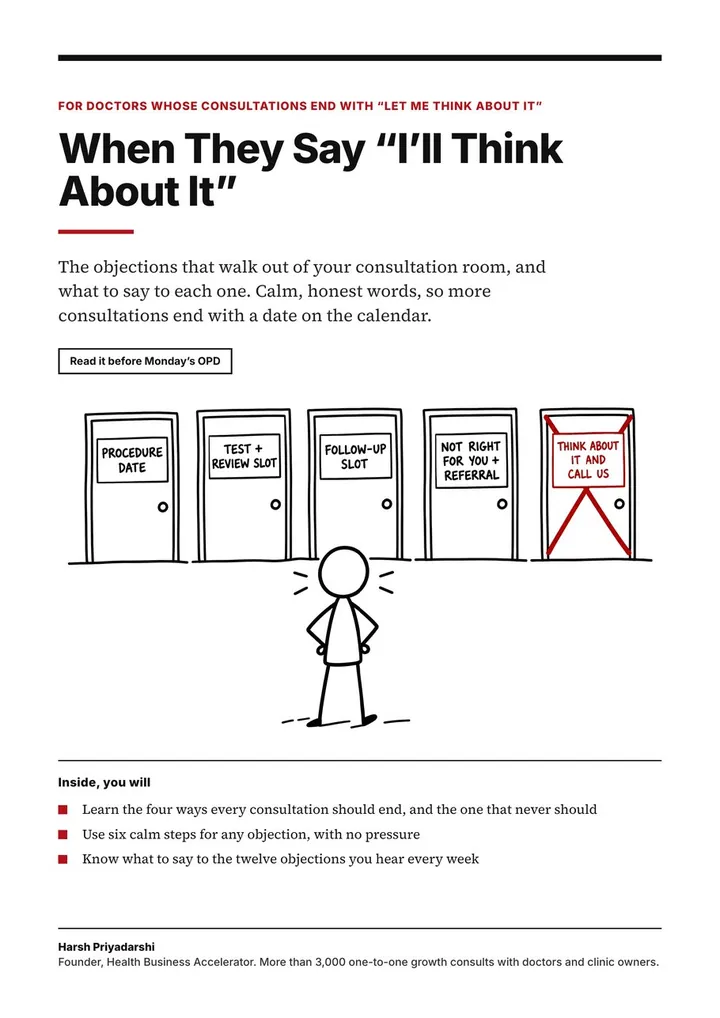
Had the Nizamabad family come in, the surgeon would first have explained what the X-ray shows and what walking without support would look like for their father. Then the three plans, the fullest first. Then which one he would choose and why. Only then the price, said once, followed by silence while the family thinks. That family would have had something real to compare, instead of three bare numbers.
Example: say a knee replacement plan at your Hyderabad clinic has three versions at ₹2,20,000, ₹2,80,000 and ₹3,40,000, built around the implant choice and the length of physiotherapy support. Most families, once they understand the difference, choose the recommended plan. The ones who choose Basic do it knowing exactly what they are getting. Every option must be genuinely different in outcome, never a fake option to push people upwards.
Should you charge for the consultation?
Yes. A paid consultation signals value and brings in patients who are serious. If you want to soften it, adjust the fee against the plan when they go ahead. When a caller says another clinic offers a free consultation, your desk should not argue. It should explain calmly that this is time with the specialist, with an examination and a written plan, and let the patient choose.
What do you say when patients ask for a discount?
Never discount, and never run limited-period offers. A 20% discount on a plan that costs you 40% to deliver means you need 50% more patients just to make the same profit. And it teaches patients your price was never real.
When a relative says "thoda kam karo" or asks in Telugu for something off, the coordinator should not bargain. She explains, kindly and the same way every time, that every family pays the same fee, and then shows what can change: a simpler plan, or a different way of paying.
In practice, that leaves four moves, none of which touch the price:
- Offer the Basic plan if the budget is truly tight.
- Offer milestone payments: a part at booking, a part on the day, the rest during aftercare.
- Offer EMI through two or three lending partners, so the patient sees a monthly figure. The ₹2,80,000 knee plan over 24 months is about ₹11,700 a month.
- Go back to the outcome the patient told you they want.
Remember that a no-cost EMI is never free. Usually the clinic pays the lender's fee, so build it into your margin. And when a son or daughter abroad is paying, make sure the written plan, the payment options and the monthly figure reach them too.
How do you know your price is right?
Pick a position first. In Hyderabad you sit between big hospital brands at one end and budget clinics at the other. The middle, a little cheaper than one and a little dearer than the other, is where clinics get forgotten. Decide whether you are premium, a niche specialist for one problem, or volume, and build the experience to match.
Then let the numbers tell you. If your consult conversion has stayed above 50% for a full quarter, or patients wait weeks for a slot, you are probably underpriced. Track which of the three options patients pick. If most choose Basic, your Recommended plan is overpriced or badly explained. If many choose Complete, it is time to raise prices or add a higher tier.
How should fees be quoted on the phone?
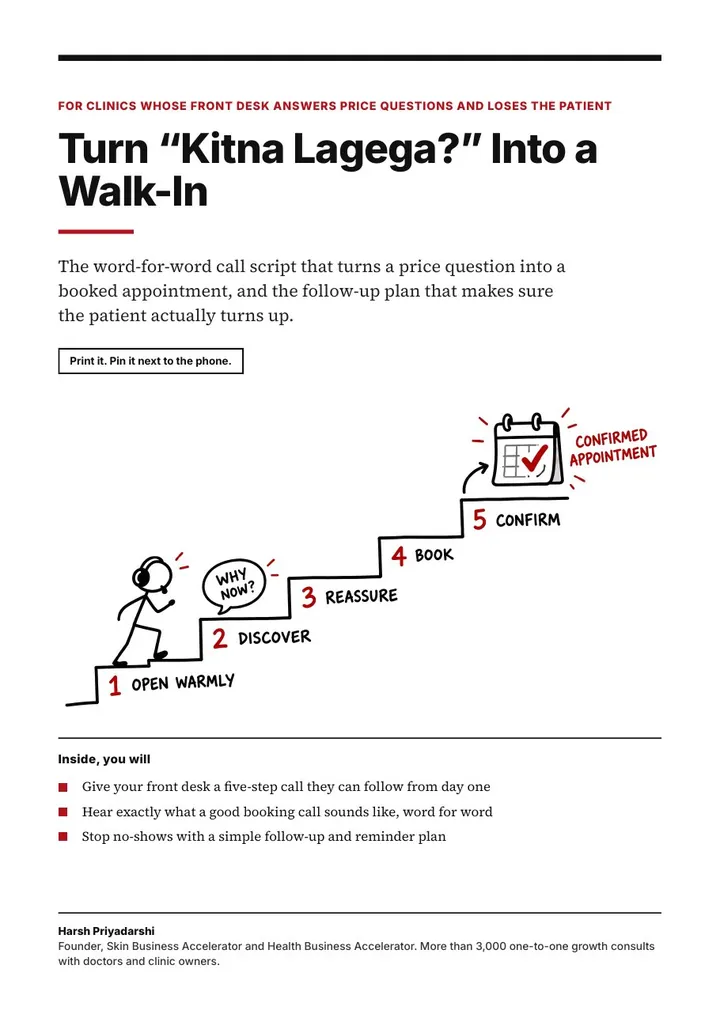
Give an honest range, explain what it depends on, and invite the patient in for an exact written plan. A price without a diagnosis is just a number to compare. Every person in the clinic should quote from the same written fee sheet, so the patient never hears three different numbers. Our front desk and conversion work includes this sheet and the scripts around it, and Good Doctors Go Broke covers pricing in full.
We work with clinics across India, including Hyderabad, mostly on video calls. Our Hyderabad page has more, or book a free growth call.
The short version
- Price the plan that gets the result, not each visit or graft.
- Offer three honest options, recommend one, and say the price last.
- Charge for the consultation and never discount. Change the scope or the payment instead.
- Give district and overseas family members the full written plan and the monthly figure.
Frequently asked questions
How do I stop patients comparing my price with big hospitals?
Stop quoting single numbers. Price the whole plan, explain what it includes and what happens at each step, and invite the patient for a written plan after an examination. When patients compare outcomes and care instead of one number, specialist clinics usually compete very well.
Should a Hyderabad clinic offer EMI?
Yes, as a normal option for everyone. Partner with two or three lenders so more patients get approved, show the monthly figure next to the total on every written plan, and explain all costs clearly. Build any no-cost EMI fee into your pricing so it does not eat your margin.
What should my front desk say when someone asks the price on the phone?
Give an honest range, explain that the exact plan depends on the examination, and offer two specific consultation slots. For example, say it depends on how much needs to be treated and the plan that suits them, and the doctor will give the exact plan in writing.
How often should I raise my fees?
Once a year, on a fixed date, usually enough to cover rising costs. Raise for new patients first, honour every existing plan and quote, and train your team before the change. Watch booking and conversion for eight to twelve weeks afterwards before you change anything else.
On a free growth call, my team traces your last month from enquiry to treatment and shows you your biggest leak in rupees.