Hair transplant surgeons convert more consultations by pricing outcome plans instead of grafts. Narrate the scalp examination, draw the planned hairline on the patient's forehead, link the plan to his reason for acting now, then present three options covering the procedure, a year of supporting care and reviews. Recommend one, let a coordinator explain EMI and milestones, and never discount.
A hair transplant surgeon we worked with quoted every patient a price per graft, just like every other clinic in his city. So patients did the obvious thing. They called five clinics, compared the per-graft number and went with the cheapest. He was being shopped like a commodity. He replaced the graft quote with three hairline restoration plans built around outcomes, started recommending one after every diagnosis, and stopped quoting exact prices on the phone. Patients stopped comparing grafts and started comparing outcomes. On outcomes, he had no real competition.
How should a hair transplant consultation run?
Twenty minutes, with a structure the patient can feel:
- Frame it. "First I'll understand what's been happening, then I'll examine your scalp, and by the end you'll know exactly where you stand, your options and what I'd recommend."
- Listen. When did it start, what has he tried, how does it affect his day, why now, and what would it mean to have it sorted.
- Narrate the examination. Show him his scalp under magnification. "The follicles here at the front are getting thinner. That's why the hairline keeps moving back."
- Be honest about the diagnosis. Hair loss like this is progressive. Oils will not reverse it, and every year of waiting leaves less to work with. Say it to inform him, not to scare him.
- Draw the hairline on his forehead. This is the most powerful moment in the room. He sees the result on his own face, designed for his age, before he decides.
- Connect it to his words. "You told me you want to stop wearing a cap at your wedding. Here's how we get you there."
- Recommend one plan out loud, then introduce the coordinator by name for the fee conversation.
- End with a definite next step: a surgery date, a review slot, a family session, or an honest "you're not a good candidate yet".
That last option matters. A man with very early loss, or a donor area that cannot support what he wants, deserves to hear it. That one honest "no" builds more referrals over the years than any closing line.
What should hair transplant plans include?
Stop pricing grafts. Price the plan that gets him the result and protects it. Here is an example. The fees are illustrations only.
| Basic | Recommended | Complete | |
|---|---|---|---|
| Procedure | Hairline restoration | Hairline restoration | Hairline and crown restoration |
| Supporting care | Not included | Medicines and supporting sessions for the first year | Medicines and supporting sessions for the first year |
| Reviews | One review | Reviews at three, six, nine and twelve months | Reviews for two years |
| Support | Clinic helpline | One coordinator start to finish, direct WhatsApp line | Same, plus priority access to the surgeon |
| Example fee | ₹1,10,000 | ₹1,50,000 | ₹2,20,000 |
Present the diagnosis first, then his outcome, then the options from Complete down to Basic, your recommendation and the price last. Every option must be honest. Basic is a genuine, safe procedure without the extras that protect the rest of his hair. If most men choose Basic, your Recommended plan is overpriced or badly explained.
Charge for the consultation, and say so confidently on the phone. A paid consultation with the surgeon signals that this is a medical decision, not a showroom visit, and it brings in men who are serious. If you want to soften it, adjust the fee against the plan when he goes ahead. Raise your plan fees once a year on a fixed date, for new patients first, honouring every written quote already given.
Give it a named method too. Design, harvest, place, protect. Four phases on one page, hanging in the consultation room, so he can point at where he is in the journey.
How should hair clinics handle payment and EMI?
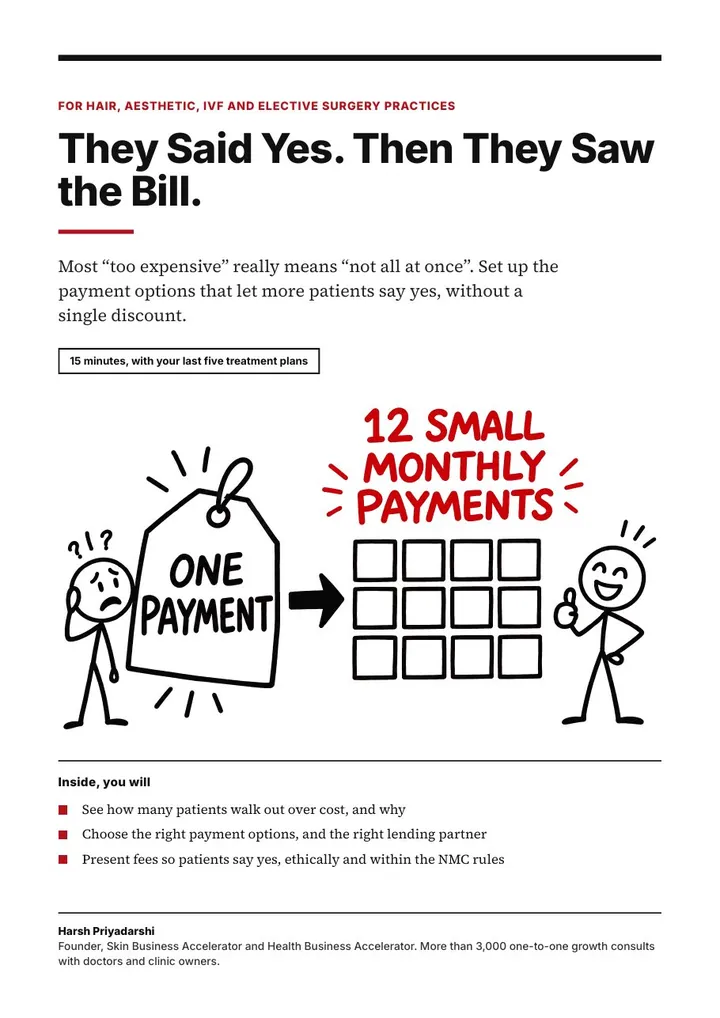
A hair clinic we worked with kept losing men who clearly wanted the procedure but could not pay the full amount at once. They had never offered financing. Once they brought in two lending partners, trained the coordinator to explain EMI simply and put the monthly figure next to the total in every plan, men who had been saying "maybe next year" started booking right after the consultation.
Example: A ₹1,50,000 Recommended plan over 12 months is ₹1,50,000 ÷ 12 = ₹12,500 a month. A Complete plan at ₹2,20,000 is about ₹18,300 a month. The difference per month is small, which is why financing also lifts the share of men who choose Recommended or Complete.
Milestones work beautifully with a named method: a part at booking, a part on surgery day, and the rest across the protect phase. Elective cosmetic procedures, including hair transplants, are generally taxable under GST, so confirm with your chartered accountant how it applies to you and show the full amount clearly in the written plan. No surprises.
What do you say to the common hair transplant objections?
| What he says | What he usually means | How to respond |
|---|---|---|
| "I'll think about it" | Usually money, fear or family | "Can I ask what you'd like to think over?" Then book a follow-up before he leaves |
| "It'll look fake" | "Will people know?" | The hairline drawing, results from men like him, how grafts are angled |
| "I'll try medicines first" | "Maybe I don't need surgery" | If he has already tried them, explain honestly what more of the same means |
| "I had a bad transplant before" | "Why trust anyone again?" | Listen fully, then explain exactly where your process differs |
| "Can you reduce it?" | "Can I afford this?" | "Is it the total, or paying it all at once?" Then scope or EMI |
A hair clinic losing most undecided men to "I'll think about it" trained the team to ask one question: "Can I ask what you'd like to think over?" Most of the time, it was the payment or what the family would say. Handling that on the spot, and booking a follow-up for everyone who still wanted time, meant far fewer disappeared.
If money is the obstacle, adjust the plan or the payment schedule. The price itself stays put. Our conversion systems work sets up the coordinator, the written plan and the follow-up.
The short version
- Per-graft pricing makes you a commodity. Price outcome plans instead.
- Narrate the scalp exam, draw the hairline on his forehead and tie it to his "why now".
- Offer three honest plans with supporting care and reviews, and recommend one.
- Show EMI and milestones next to the fee, and check GST treatment with your CA.
- Never discount. See our hair transplant page and Good Doctors Go Broke.
Official sources
Rules change. Check the current version at the source before you act.
Frequently asked questions
Why should hair transplant clinics stop quoting per graft?
Per-graft quotes make patients compare one number across many clinics and choose the cheapest, and graft count alone says nothing about design, donor protection or aftercare. Pricing an outcome plan, with the procedure, a year of supporting care and scheduled reviews, makes patients compare results and care instead, where a skilled surgeon wins.
How do I convert more hair transplant consultations?
Frame the consultation, listen for why he is acting now, narrate the scalp examination and draw the planned hairline on his forehead. Then recommend one of three plans clearly, hand over to a coordinator for fees and EMI, and end every consultation with a definite next step, such as a surgery date or a booked follow-up.
Should hair transplant clinics offer EMI?
Yes, for most clinics it helps, because many men want the procedure but cannot pay it all at once. Work with two or three lending partners, show the monthly figure next to the total, offer it to everyone, and explain the full cost clearly. If you offer no-cost EMI, build the lender's fee into your pricing.
Is GST charged on hair transplant surgery in India?
Elective cosmetic procedures, including hair transplants, are generally taxable under GST, unlike most core healthcare services. The details depend on your situation and can change, so sit down with a chartered accountant who works with healthcare, confirm what applies to you, and show the full amount clearly in every written plan.
On a free growth call, my team traces your last month from enquiry to treatment and shows you your biggest leak in rupees.