A Gurugram clinic should treat WhatsApp as the main front door: reply to every enquiry within seconds, ask whether the patient prefers a call or chat, and reach them by phone within five minutes when they can talk. Answer in English and switch to Hindi easily, keep conversations discreet, offer two specific slots including evenings or Saturday, and confirm with the tower, floor, gate and parking.
For many Gurugram patients, the first contact with your clinic isn't a phone call. It's a WhatsApp message sent from a meeting room, a cab or the sofa at midnight. A woman planning a pregnancy, or worried about symptoms she'd rather not discuss at her desk, will often type before she'll talk.
If your front desk is built only around the phone, you are answering a door most patients no longer knock on. Let me use a gynaecology and obstetrics practice as the example.
How fast should a Gurugram clinic respond?
The benchmarks are the same everywhere. What changes in Gurugram is the channel.
- Answer rate: at least 95% of calls in working hours picked up by a human.
- Speed to first contact: a human touch within five minutes, ideally within thirty seconds.
- WhatsApp: an instant automatic reply, then a real person in the chat within minutes during working hours.
- After hours: a reply that says exactly when someone will respond, and a message first thing in the morning.
Patients here often message three clinics at once. The one that replies first and sounds like it cares usually wins.
Which language should the front desk use?
Start in English, which most enquiries in Gurugram will use, and switch to Hindi the moment the patient does. Many patients are more comfortable describing symptoms in Hindi, and older family members almost always are. Patients from other parts of India may prefer English throughout. Follow the patient, never the script.
For women's health, also think about who answers. Many patients are more comfortable speaking to a woman about gynaecological concerns. If you can, make sure a female team member is available for those conversations.
How do you keep enquiries discreet?
This matters more in gynaecology than almost anywhere else, and it matters in a city where people take calls in open offices.
- Ask before calling: "Is now a good time to talk, or would you prefer to continue here?"
- Never leave detailed voicemails about the reason for the visit.
- Never send messages that reveal a diagnosis or a sensitive concern.
- Confirm the name the patient prefers to be called and who else, if anyone, should be contacted.
- Keep all patient conversations in a shared business inbox, not on personal phones.
What does a good WhatsApp-to-booking conversation look like?
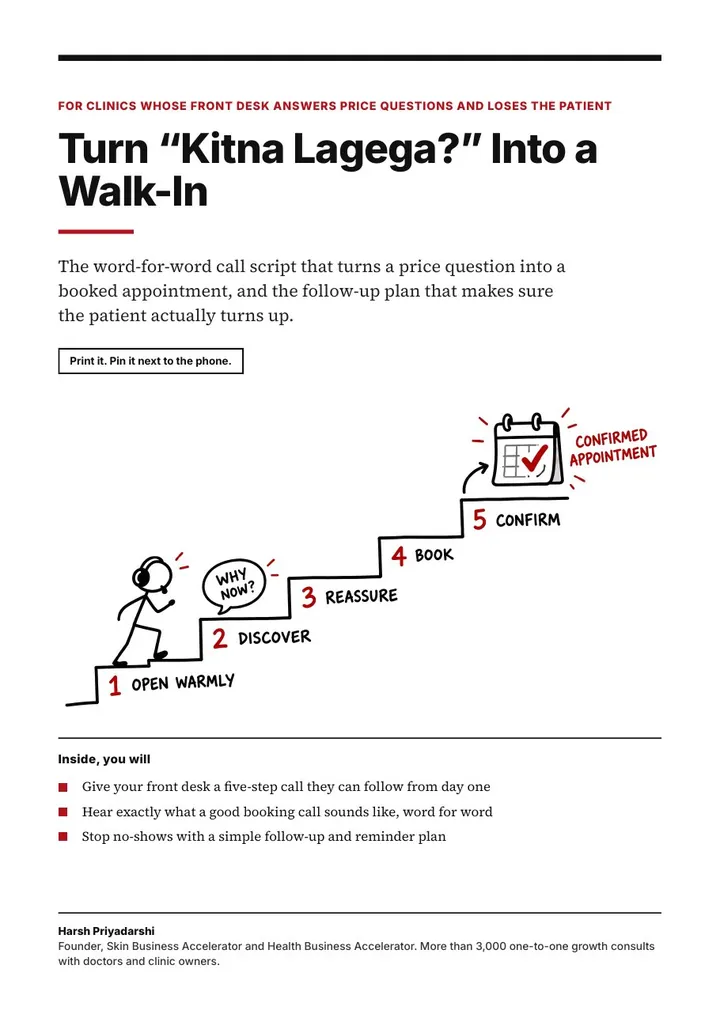
Every conversation still follows the five steps: open warmly, discover, reassure, book with two slots, confirm. Here is an example. Names, slots and the fee are only illustrations.
Patient (WhatsApp, 9:40 pm): "Hi, what's the consultation fee? I want to see a gynaecologist."
Auto reply: "Thank you for messaging. This is the clinic of Dr Sharma. Someone from our team will reply in the morning by 9 am. Would you prefer a call or to continue on WhatsApp?"
Patient: "WhatsApp please."
Front desk (8:55 am): "Good morning, this is Neha from Dr Sharma's clinic. The consultation fee is ₹1,200. May I ask your name, and whether this is your first visit with us?"
Patient: "I'm Ritu. First visit. We're planning a pregnancy and I want a check-up before that."
Front desk: "That's a lovely reason to come in, Ritu. Dr Sharma sees many couples for exactly this. Is there anything else you'd like the doctor to know before the visit?"
Patient: "My cycles have been a bit irregular."
Front desk: "Thank you for sharing that. The doctor will go through everything with you and explain what, if any, tests are needed. I have Thursday at 6:30 pm or Saturday at 10 am. Which works better?"
Patient: "Saturday."
Front desk: "Booked for Saturday at 10 with Dr Sharma. I'm sending the location pin now. We're in Tower B, 3rd floor. Please use the side gate for parking. Bring any previous reports. We'll remind you on Friday."
Notice what the front desk didn't do. No medical advice. No guessing at what "irregular" means. Just warmth, discovery, two slots and clear directions.
Why do directions matter so much in Gurugram?
Because many clinics sit inside large commercial complexes, malls or towers, and the last 200 metres lose patients. Confirm every booking with:
| Detail | Example |
|---|---|
| Location pin | The exact entrance, not just the building |
| Tower and floor | "Tower B, 3rd floor, left from the lift" |
| Gate and parking | Which gate, which parking level, any visitor pass |
| Metro option | The nearest station and the walk from it, if relevant |
| What to bring | Previous reports, current medicines |
| Reminders | The day before, asking to confirm, and two hours before |
If someone doesn't arrive, call the same day, warmly, to reschedule. Traffic and meetings are common reasons here, and a quick rebook keeps the patient.
How do you follow up enquiries that go quiet?
Three attempts on day one, then day two, day four, day seven and day fourteen, mixing calls with short, useful WhatsApp messages. For example, on day four a short note: "Dr Sharma has a few evening slots next week, if that's easier around work." Never pushy. Only then mark it cold, and keep it in the database.
Our CRM, WhatsApp and AI work builds the shared inbox, instant replies and reminders, with clear hand-offs to a human for anything sensitive. Our conversion systems and team training services write and practise these scripts with your team. The gynaecology page covers the rest of that journey, and the Gurugram page explains how we approach the city.
How do you check the front desk is doing it well?
Review a few WhatsApp conversations and three recorded calls every week, with the team, scoring each on the five steps. Track answer rate, speed to first contact, booking rate (25 to 40% of enquiries is healthy) and show rate (60 to 75% of bookings). When a number drops, the conversations show you why.
The short version
- In Gurugram, WhatsApp is often the front door. Reply in seconds and ask how the patient prefers to talk.
- English first, Hindi the moment the patient switches, and a female team member for women's health where possible.
- Be discreet: ask before calling, no detailed voicemails, a shared business inbox.
- Five steps, two slots including evenings or Saturday, and directions down to the tower, gate and parking.
- Review chats and calls every week against the five steps.
Frequently asked questions
Should my Gurugram clinic reply to patients on WhatsApp or call them?
Both, in the order the patient prefers. Reply on WhatsApp within seconds, ask whether they would like a call or to continue chatting, and call within five minutes if they want to talk. Many professionals can't take calls at work, so letting them choose usually lifts bookings.
How do I handle late-night patient enquiries at my clinic?
Send an instant reply that says exactly when someone will respond, then reply first thing in the morning before other clinics do. An AI assistant can also answer basic questions and offer real slots, as long as it never gives medical advice and hands anything sensitive to a human.
What should a front desk avoid saying to gynaecology patients?
Avoid any medical advice, any guess about what a symptom means, and anything that could embarrass the patient if overheard or seen on a screen. Ask before calling, never leave detailed voicemails, and keep conversations in a business inbox. Warmth and discretion matter more than speed of information.
Why do patients book but not show up at my Gurugram clinic?
Often because of traffic, meetings or confusion about where exactly the clinic is. Send a location pin with the tower, floor, gate and parking details, remind the day before and two hours before, and call no-shows the same day to rebook. Evening and Saturday slots also help.
On a free growth call, my team traces your last month from enquiry to treatment and shows you your biggest leak in rupees.