A Gurugram clinic should price an all-inclusive plan built around the outcome, present three honest options with one recommendation, and put the fee, insurance help and EMI options on one written page. Patients here compare hospital packages online, so give an honest range on the phone, explain exactly what is included, choose a premium or niche position, and never discount to match a competitor.
"Can you send me your package?" In Gurugram, that message arrives on WhatsApp before many patients have even met the doctor. They have already looked at two hospital websites, asked a colleague, and maybe got a quote from a clinic on the other side of the city.
Patients here are informed and they compare. That is not a reason to be cheaper. It is a reason to price in a way that makes the comparison fair, and makes your value obvious. Let me use an orthopaedic sports injury practice, and a ligament reconstruction patient, as the example.
Why do Gurugram patients compare packages so closely?
Three things are true about many patients here.
First, they are used to all-inclusive pricing from large hospitals, so a bill that arrives in parts feels like a trap.
Second, many have group health insurance through their employer, and they want to know what the policy covers and what they will pay themselves.
Third, they value their time. A plan that includes weekend physiotherapy or early morning review slots is worth more to a working patient than a slightly lower number with no flexibility.
So the question is not "how do we match the cheapest quote?" It is "how do we show exactly what the patient gets, and why it is worth it?"
What does pricing the plan look like for a sports injury?
Don't price the surgery alone, with the implant, the room and the physiotherapy billed separately. Price the outcome: getting back to running, playing or simply climbing stairs without fear.
| Pricing the parts | Pricing the plan |
|---|---|
| Surgeon fee, room, implant, physiotherapy and reviews billed separately | One plan from the first scan to the return-to-activity review |
| The family can't work out the final cost | The full number is known on day one, in writing |
| Physiotherapy dropped halfway because each session is a new decision | Rehabilitation sessions booked in advance and included |
How do three options work here?
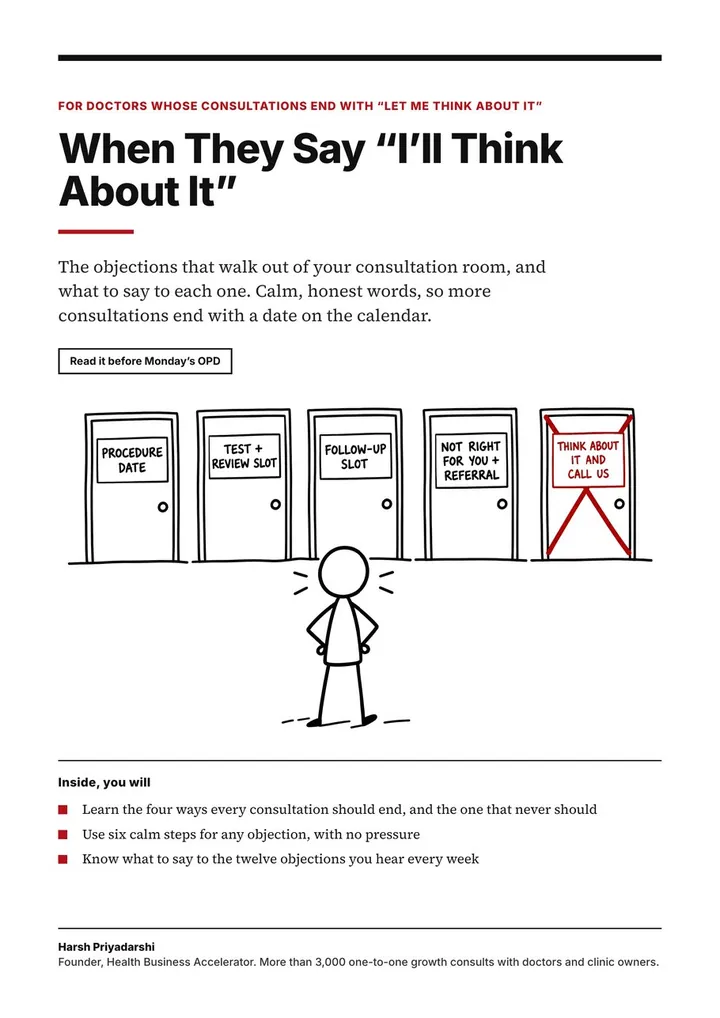
Build Basic, Recommended and Complete versions, with honest differences in outcome and support.
- Basic: the surgery and the essential rehabilitation, safe and effective.
- Recommended: surgery plus a structured rehabilitation plan and planned reviews through recovery. The plan you would choose for this patient.
- Complete: everything in Recommended plus extra support, such as more supervised sessions, flexible timings or a longer review period.
Present the diagnosis, the outcome, the options from Complete down to Basic, your recommendation, and the price last. Then say plainly which one you recommend and why.
How should insurance and EMI fit in?
Put the payment options on the same page as the fee.
Insurance: if you are empanelled with the patient's insurer, your TPA desk checks their policy and explains, before admission, what is covered and what isn't. Never guess and never promise cover. A surprise bill on discharge day is what patients remember.
EMI and credit card EMI: many Gurugram patients are comfortable with both. Partner with two or three lenders, and know who pays the interest on any no-cost EMI. Usually it is you.
Milestones: part at booking, part at surgery, the rest during rehabilitation.
Example: Say the Recommended plan is ₹2,40,000. Spread over 12 months, that is ₹20,000 a month. Say the patient's insurance covers part of the hospital stay. Show what remains, and the monthly figure for that amount. Same plan. A clear path to yes.
What do you say when a patient sends a cheaper quote?
Don't argue and don't match it. Compare properly, on what is included and the care around it.
Coordinator: "Can I see what their quote includes? Let's compare it line by line, the rehabilitation, the reviews and what happens if you need extra support."
Often the cheaper quote leaves out rehabilitation or reviews. If it truly includes the same, explain calmly what is different about your approach and let the patient choose.
And remember the maths of discounting.
Example: Say your plan is ₹2,40,000 and it costs ₹1,20,000 to deliver. Profit: ₹1,20,000. A 10% discount brings the price to ₹2,16,000. Cost stays ₹1,20,000. Profit: ₹96,000. To earn the same total, you need ₹1,20,000 ÷ ₹96,000 = 1.25 times as many patients.
Give the team one line: "Our fees are the same for every patient. If budget is a concern, we can look at another option or spread the payment."
What should the front desk say when someone asks for the package?
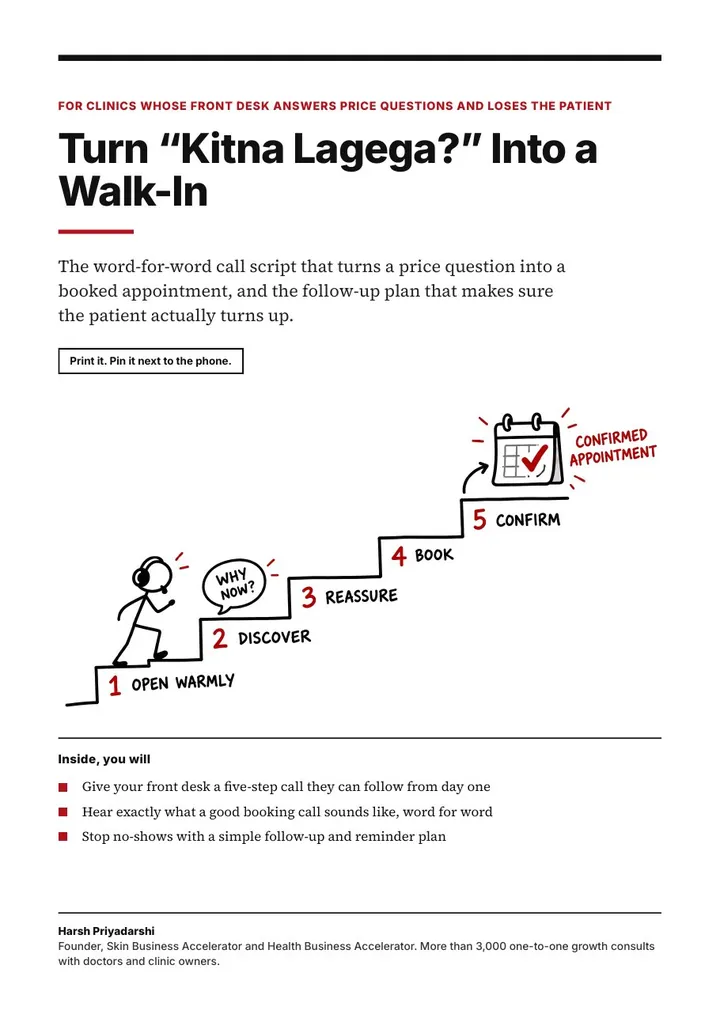
The first price conversation usually happens on WhatsApp or the phone, long before the patient meets the doctor. Give the front desk one approach and make everyone use it.
Front desk: "The exact plan depends on the doctor's examination and your scans, so the doctor will give you a written plan with the full cost after the consultation. For most patients it falls within a range, it includes rehabilitation and reviews, and we help with insurance and EMI. I have Saturday at 10 or Tuesday at 7 in the evening. Which suits you?"
That answer is honest, it shows transparency, and it ends with two slots that fit a working week.
Where should a Gurugram practice sit in the market?
Pick a side. Premium, niche specialist or volume. In Gurugram, a small practice can't win on volume against large hospitals, and the middle gets forgotten. The strongest position for most independent specialists here is a premium niche: known for one problem, priced at the top of the market, with an experience to match, such as longer consultations, one coordinator from start to finish and genuinely flexible scheduling.
Mystery-shop the ten options your patient compares you with, including the hospitals, and find the gap you can win on. Then raise fees once a year, on one fixed date, for new patients first, and honour every existing quote.
Our conversion systems work builds fee sheets, written plan templates and coordinator scripts like these, and our orthopaedics page covers the joint and sports injury journey. For the full framework, see Good Doctors Go Broke, and for the city view, our Gurugram page.
The short version
- Gurugram patients compare packages, so price an all-inclusive plan they can understand.
- Three honest options, one recommendation, and the price said last.
- Fee, insurance help, EMI and milestones on one written page.
- Compare cheaper quotes line by line, and never discount to match.
- Choose a premium niche position rather than the forgotten middle.
Frequently asked questions
Should I send my treatment package price on WhatsApp before a consultation?
Share an honest range and what it depends on, explain what the plan usually includes, mention insurance help and EMI, and invite the patient for a consultation where they get the exact plan in writing. A full price before a diagnosis is just a number to compare, and it is often wrong.
How do I compete with hospital packages in Gurugram?
Don't compete on price. Price an all-inclusive plan, show exactly what is included, and win on what large systems find harder: the specialist's time, one coordinator throughout, flexible scheduling and fast replies. Help patients compare quotes line by line rather than on the headline number.
Is no-cost EMI a good idea for my clinic?
It can help conversion, but the interest doesn't disappear. In most no-cost EMI schemes the clinic pays a fee to the lender. Work out that cost per plan, build it into your pricing, and use it only where your margin can carry it. Offer standard EMI elsewhere.
How should my clinic explain insurance coverage to patients?
Have a trained TPA or insurance desk check each patient's policy and explain, before admission, what is covered and what they will pay. Put it in writing next to the plan. Never guess or promise cover. Unexpected bills at discharge damage trust more than almost anything else.
On a free growth call, my team traces your last month from enquiry to treatment and shows you your biggest leak in rupees.