Cardiology retention means keeping patients under your care long after the procedure or first visit. Build a recall calendar from your own clinical protocol, book every review before the patient leaves, call anyone who misses one within a day, and make sure rehab programmes are completed. Reactivate lapsed patients with care-led messages, welcome the family, ask for reviews at happy moments, and report back to every referring doctor.
Here is a pattern I see in a lot of cardiology practices. The angioplasty goes well. The patient is discharged with a medicine list and a vague "come back for review". Six months later, the family physician is managing everything, the patient has not seen a cardiologist since, and nobody at your clinic noticed.
That is not just lost revenue. Heart care is long-term care. A patient who drifts away after the procedure is a patient whose long-term care is no longer in your hands. Retention in cardiology is clinical continuity, run as a system.
Where does lifetime value come from in a cardiology practice?
Lifetime value grows from six places, and every one of them shows up clearly in cardiology:
- Completion: finishing what was started, especially cardiac rehab after a procedure.
- Follow-ups and reviews: the medication reviews, test reviews and device checks your protocol calls for.
- Related care: a patient seen for blood pressure who later needs a heart failure review, or a pacemaker patient who needs regular device checks.
- Family: the spouse who comes to every visit, and the adult children with the same family history.
- Long-term plans: an annual preventive or heart failure plan with scheduled reviews.
- Reputation: the family that tells everyone at the next wedding, "Go to our doctor."
If you only fix one of these, fix the first two.
How should a cardiology recall calendar work?
Your recall intervals come from your clinical protocol, not from marketing. Write down, for every service, when the patient should return, what is checked, and which warning signs they must call about. Then put it into the system.
Example: Say your protocol after an elective angioplasty is a review at one month, three months and six months, then yearly. At discharge, the coordinator books the one-month review before the family leaves. At that visit, the three-month review is booked. Every review gets a WhatsApp reminder a few days before and a call for anyone who does not reply.
The same logic applies to a blood pressure clinic, a lipid clinic, a pacemaker clinic or a post-rehab review. Whatever the interval is, it lives in your CRM, not in the patient's memory.
Anyone who misses a review gets a warm call within a day. Not "you missed your appointment", but "how are you feeling, and what got in the way?" Most misses happen for small reasons: a son who was travelling, a clash with work, or a patient who feels fine and assumes the review does not matter.
How do you get patients to complete cardiac rehab?
Rehab is where many cardiac patients drop out, usually in the slow middle when they already feel better. Fix it the same way you fix any plan:
- Book every session on the day they start, not one week at a time.
- Show progress. Record the walking distance or exercise capacity your team tracks, and share it with the patient at each phase.
- Mark the milestones. If your rehab programme has named phases, celebrate each one.
- End with a completion review with the cardiologist, where the next review is booked before they leave.
Who should a cardiology practice reactivate first?
Your database already holds patients you paid to acquire. Clean it, keep only people who agreed to hear from you, and split it by situation. One blast to everyone helps nobody.
| Group | A genuine reason to reconnect |
|---|---|
| Procedure patients overdue for review | "It has been a year since your procedure. It's time for your review." |
| Patients advised a test who never did it | A short note from the doctor offering to answer any questions about the test |
| Rehab patients who stopped halfway | A personal call from the coordinator asking what stopped them |
| Preventive check-up patients from last year | A reminder that their annual check is due, booked around their schedule |
| Happy long-term patients | Something genuinely new, like a heart failure clinic or a new rehab programme |
Lead with care, not offers. The best reactivation message does not sell. It remembers. Every reply should reach a real person within minutes. Our retention and reactivation work runs this as a monthly routine, not a one-time campaign.
How do referrals grow in cardiology?
Two kinds of referral matter.
Patients and families. Ask at the moments people are happiest: the review where the reports look good, the last day of rehab, the visit where the breathlessness is finally gone. Say it simply: "If anyone you know is going through something similar, we would be glad to help." Give them a short WhatsApp message they can forward. Add a "referred by" field for every new patient. Thank every referrer personally, and never pay for a referral.
Welcome the family members who come to reviews. With consent and when it is clinically appropriate, they may need a check-up of their own.
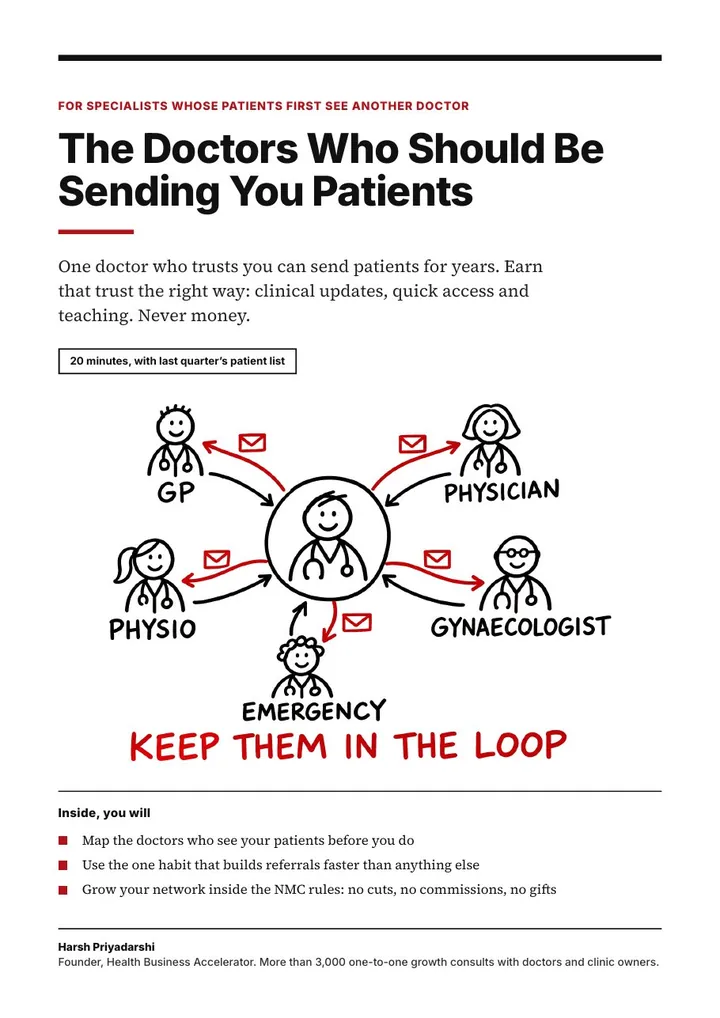
Referring doctors. The physician or GP who sent the patient wants to know what happened. Send a short summary after the consultation and after any procedure, with consent. And send the patient back for the care the referring doctor can give. A physician who sees you return patients keeps sending them.
What should a cardiologist measure every month?
Track plan completion (including rehab), review attendance, how many patients come back within a year, referrals from patients and from doctors, new reviews and your reply time, and lifetime value every quarter.
Example: Say your practice did 600 elective procedures in the last three years, and 240 of those patients have not been reviewed in over a year. If a reactivation routine brings back 70 of them, at ₹2,500 per review visit, that is ₹1.75 lakh from reviews alone, before any tests, plans or related care they need.
The method is in Good Doctors Go Broke, and our CRM and automation setup keeps the calendar running.
The short version
- In cardiology, retention is long-term clinical care run as a system.
- Turn your clinical protocol into a recall calendar, book each review before the patient leaves, and call misses within a day.
- Book every rehab session upfront, show progress and end with a completion review.
- Reactivate by situation, with care-led messages, and answer every reply within minutes.
- Report back to referring doctors, thank referring patients, and never pay for referrals. More on our cardiology page.
Frequently asked questions
How often should cardiology patients come back for follow-up?
That depends on your clinical protocol for each condition and procedure, so the cardiologist sets it, not the marketing team. What matters is that every interval is written down, entered in your CRM, booked before the patient leaves each visit, reminded on WhatsApp beforehand and followed up with a call within a day if missed.
How do I bring back cardiac patients who stopped follow-up?
Split them by situation first: overdue reviews, tests advised but not done, rehab stopped halfway and past preventive check-ups. Send each group a personal, care-led reason to return, only to people who agreed to hear from you. Make sure a real person calls everyone who replies within minutes, and book the visit on that call.
How can a cardiologist get more referrals from physicians?
Report back after every referral, with the patient's consent, and send patients back for the ongoing care the physician can give. Make referring easy with a direct WhatsApp line and priority slots, and run small teaching sessions for local doctors. Never pay or accept any fee for referrals.
When should a cardiology clinic ask patients for a review?
At the moments patients feel best: a review where the reports look good, the end of a rehab programme or the visit where symptoms have eased. Avoid the day of an emergency or procedure. Ask every patient, not only the happy ones, and never offer anything in return for a review.
On a free growth call, my team traces your last month from enquiry to treatment and shows you your biggest leak in rupees.