Cardiologists in India get more patients by growing planned care, not emergencies. Start with three channels: a strong Google profile with a page for every test and procedure, Google search ads for intent searches like "cardiologist near me" or "angiography cost", and a referral network of physicians and GPs. Get on the insurance panels your patients hold, and judge every channel by cost per treated patient.
Cardiology is not like other specialities when it comes to marketing. A man having a heart attack at 2 am goes to the nearest hospital with a cath lab. No ad, reel or review changes that. So many cardiologists decide marketing is simply not for them.
That is a mistake. A large part of every cardiology practice is planned care. The 52-year-old who gets breathless on the stairs. The diabetic whose physician wants an echo. The family that has been told "three stents" and wants a second opinion before they agree. The executive whose company health check flagged his ECG. These patients choose their cardiologist. This playbook is about making sure they choose you.
Where do a cardiologist's new patients actually come from?
Before you spend a rupee, sort your patients by how they reached you. In my experience, cardiology patients arrive through four doors, and each door needs a different key.
| Door | Who walks through it | What wins them |
|---|---|---|
| Emergency | Chest pain, palpitations, sudden breathlessness | Being close, open round the clock, cashless with their insurer, and easy to find on the map |
| Referral | Patients sent by GPs, physicians, diabetologists and nephrologists | A doctor who trusts you, and a report back after every patient |
| Self-search | People looking for an echo, a TMT, an angiography or a cardiologist near them | A strong Google profile, a page for each test, and a phone that gets answered |
| Prevention | Executives, people with a family history, senior citizens | Corporate health checks, society talks and simple screenings |
Add a "how did you find us?" question to every new enquiry and log the answer in your CRM for one month. Most cardiologists I speak to guess wrong about which door is the biggest.
Which three channels should a cardiologist start with?
My rule from Known Doctors Get Booked is simple: start with three channels, one free, one paid and one that builds trust. And never let one channel bring in more than half your new patients.
For most cardiologists, it looks like this.
Free: your Google profile and condition pages. Build one page for each thing patients search for by name: 2D echo, TMT, Holter monitoring, angiography, angioplasty, pacemaker, heart failure care. Each page explains what happens, how long it takes, how to prepare and what it costs or how pricing works.
Paid: Google search ads. In my experience, very few planned cardiac patients discover their need from a reel. They search because a physician told them to get a test done, or because a symptom is worrying them. That is intent, and intent is Google's world.
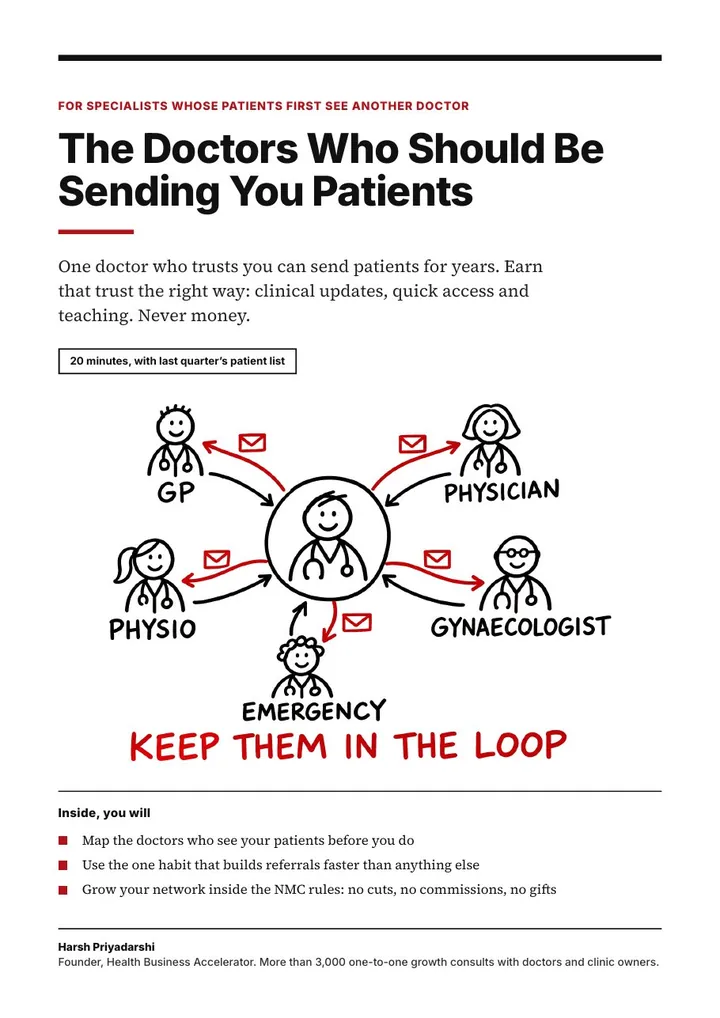
Trust: the referral network. Most of your planned patients see another doctor before they see you. That makes physicians and GPs your most valuable channel.
And on day one, before any of this, reactivate your database. Every angioplasty patient who has not been reviewed in a year, and every patient who was advised a test and never did it, is one phone call away.
How do you build a referral network with physicians and GPs?
Start by listing every doctor who sees your patients first: general practitioners, physicians, diabetologists, nephrologists, chest physicians and the casualty doctors at the smaller nursing homes around you.
Then make referring effortless:
- A direct WhatsApp line for referring doctors, answered by someone senior.
- A priority slot every day for referred patients.
- A short summary to the referring doctor after the consultation and after any procedure, with the patient's consent.
- The patient sent back for ongoing care the referring doctor can give. The diabetologist keeps managing the sugar. You manage the heart.
- A small CME every quarter for local doctors, on a topic like when to refer, or how to read a borderline TMT report.
The third point matters most. Doctors refer to the specialists who keep them in the loop. And never pay for a referral. The day you pay cuts, you stop being the best cardiologist in town and become the highest bidder.
Why does being cashless decide so many cardiac cases?
Planned procedures like angiography and angioplasty are big bills, and many families carry health insurance through work. For them, the first question is often "are you cashless for my policy?", not "how good is the doctor?"
So get on the panels your patients actually hold. For one month, ask every patient which insurer they use, then apply to the most common ones first. Set up a TPA desk with one trained owner for pre-authorisations. And list your empanelled insurers on your website, condition pages and Google profile.
But check every package rate against your real cost first.
Example: Say your real cost for an elective angiography, counting consumables, cath lab time, staff and the doctor's share, works out to ₹22,000. A panel offers ₹18,000. That is ₹4,000 lost on every case. At 40 cases a month, you are ₹1.6 lakh down while feeling busy.
What numbers should a cardiologist track every week?
Use the eight weekly numbers: enquiries, speed to first contact, booking rate, show rate, consult conversion, average ticket, cost per new patient and profit.
Cardiology needs one twist. For medically advised procedures, do not measure consult conversion the way an aesthetic clinic does. Measure the share of patients you advised a test or procedure for who actually went ahead.
Example: Say you see 80 new OPD patients a month. You advise angiography for 20, and 12 go ahead. That is 60%. If next quarter only 8 of 20 go ahead, do not touch your ads. Look at what happens after the advice: the explanation, the family conversation, the payment options and the follow-up call.
For cost per new patient, aim for roughly 10 to 20% of a patient's first-year value. Say an average new cardiac patient is worth ₹40,000 to you in the first year across consultations, tests and reviews. Then ₹4,000 to ₹8,000 per new treated patient is a sensible ceiling.
What should a cardiologist never do in marketing?
Cardiology attracts more fear marketing than almost any field. "A heart attack can strike anyone, anytime" is the kind of line that gets clicks and destroys trust. Do not use it.
Stick to the general rules. No guarantees. No "best cardiologist" claims you cannot prove. No fear or shame. Written consent before you use any patient's face or story. And check the current NMC regulations before every new campaign, because the rules change.
There is also a trust problem specific to your field. Many patients worry they will be pushed into a procedure they do not need. The cardiologist who says plainly "medicines are enough for you right now, let's review in three months" earns more referrals than any ad ever will. That honesty is the foundation of our patient acquisition work, and you can see how we work with heart specialists on our cardiology page.
The short version
- Emergencies go to the nearest cath lab. Growth lives in planned care: tests, procedures, second opinions and prevention.
- Start with three channels: Google profile and test pages, Google search ads, and a physician referral network.
- Report back to every referring doctor, and never pay for a referral.
- Get on the insurance panels your patients hold, but never below your real cost.
- Measure how many advised patients go ahead, and fix the front desk and follow-up before buying more leads.
Official sources
Rules change. Check the current version at the source before you act.
Frequently asked questions
Do Google ads work for cardiologists in India?
Yes, for planned care. Patients search for tests and procedures by name, like 2D echo, TMT or angiography cost, after a physician advises them. Build one campaign per service, block junk searches, send each ad to a matching page and judge results by cost per treated patient. Ads for emergencies rarely make sense unless you run a round-the-clock cath lab.
How can a new cardiologist get patients in a new city?
Take visiting roles at two or three established hospitals that lack a strong cardiologist, and turn up on every scheduled day. Meet every doctor there and offer a short teaching session on when to involve you. Build your Google profile and test pages from day one, so patients who hear your name can find you.
Should a cardiologist be on Instagram?
It helps, but as a trust and prevention channel, not your first paid channel. Short videos explaining what a test shows or what happens during an angiography make patients and their families feel they know you. Keep every video on your area, avoid fear, and give viewers a WhatsApp number that a real person answers quickly.
Is it ethical for a cardiologist to advertise?
Yes, when the advertising is truthful and helpful. Make no guarantees, avoid fear and unproven claims, never pay or accept referral fees, and get written consent for any patient story or image. Check the current NMC regulations before each campaign, and make sure your doctor and clinic names are easy to find on every ad.
On a free growth call, my team traces your last month from enquiry to treatment and shows you your biggest leak in rupees.