A Bhopal doctor builds a personal brand by owning one problem the city can name, such as acidity that never settles or fatty liver, and saying the same thing everywhere: Hindi reels recorded in one weekly slot, longer YouTube answers for families in district towns, talks for residents' associations and offices, and a Google profile and website that match. Count enquiries, not views.
Ask a family in Bhopal which doctor they would see for a stomach problem and you rarely hear a qualification. You hear a description. "Woh pet wale doctor, jo acidity ke baare mein videos daalte hain." ("That stomach doctor, the one who posts videos about acidity.") That sentence is a personal brand. It is one problem, attached to one face, repeated by people who have never met the doctor.
Most doctors try to be known for everything they treat. The city cannot repeat "gastroenterology, hepatology, endoscopy and general digestive care". It can repeat one problem. I'll use a gastroenterologist as the example here, but the method works for any speciality.
Why should a Bhopal doctor own just one problem?
Because people can only remember one thing about you, and the problem you pick decides who calls. Pick it by numbers, not passion alone: the condition that brings in the most revenue for you and has growing demand. For a gastroenterologist, that might be acidity that keeps coming back, or fatty liver found on a routine scan.
A niche is not a cage. You still treat everything you are trained for. But every public asset you build says the same thing: your Google profile, your reels, your YouTube channel, your website and your talks. When a patient hears the same message from five places, perception turns into trust.
What should a Bhopal doctor's reels sound like?
Like you talking to a patient in your own consultation room. Plain spoken Hindi, the way people in Arera Colony and the old city both speak, with English only where patients use it themselves, such as "scan" or "report". Regional language content often does much better than English, because it feels like a conversation instead of a lecture.
Pick three or four content pillars from your patient map, and make every reel fit one of them.
| Pillar | Example reel idea | What it does |
|---|---|---|
| Myth versus fact | "Roz gas ki goli lena theek hai?" ("Is a daily antacid fine?") answered honestly | Educates and surprises |
| Warning signs | Symptoms that mean you should see a specialist rather than wait | Educates and evokes concern without fear |
| What actually happens | An endoscopy explained step by step, from arrival to going home | Removes the fear that delays booking |
| Family moments | How to convince a parent who keeps saying "kuch nahi hai, gas hai" ("it's nothing, just gas") | Evokes emotion and entertains |
Every reel should do at least two of three things: educate, evoke emotion or entertain. Open with the most surprising line from the middle of the video. One reel, one idea. And never give individual medical advice in a reel; explain the subject, then invite people to get assessed properly.
How do you stay consistent without filming every day?
Batch it. Book one fixed slot a week and record five to eight reels in one go, from scripts prepared in advance. One editor, one style, and a turnaround everybody sticks to.
- Monday: the team pulls ten real questions from last week's calls, WhatsApp chats and comments.
- Wednesday: scripts go to the doctor in Hindi, one idea each.
- Friday afternoon: one recording session, seven reels.
- The following week: one reel a day across Instagram, YouTube Shorts and Facebook.
Seven videos from one session instead of seven separate set-ups. That is the difference between doctors who last a month and doctors who last a year. Our content production team runs this rhythm for clinics.
Why does YouTube matter for families in district towns?
Because the patient deciding on a procedure, and the family deciding with them, want more than sixty seconds. A family in Sehore or Raisen may watch a fifteen-minute explanation together on the television before making the trip. By the end, they feel they have already had a consultation.
Build a library, not a channel. Ask your front desk for the twenty questions patients ask most before booking. Each is one video. Title them the way people search, in Hindi words where that's how they type: "Fatty liver kya hai aur kab chinta karein?" ("What is fatty liver and when should you worry?"). Add chapters, a link to the matching condition page and a WhatsApp link, and send the right video to every new enquiry before their visit.
Where should a Bhopal doctor give talks?
In rooms where your patients already sit. Residents' welfare associations in Arera Colony, Shahpura and along Kolar Road. Government offices and banks around MP Nagar, where people sit at desks for long hours. Industrial units, colleges and senior citizens' groups.
Build one thirty-minute talk on your one problem: the warning signs, the myths and what people can actually do. Pitch the value to the committee or HR team, not your clinic. Leave something behind, such as a one-page guide with a QR code to your condition page. Follow up with every sign-up within a day. And record every talk, with permission, because each one becomes a month of reels. Our doctor authority work plans this calendar with you.
How do you know your brand is working?
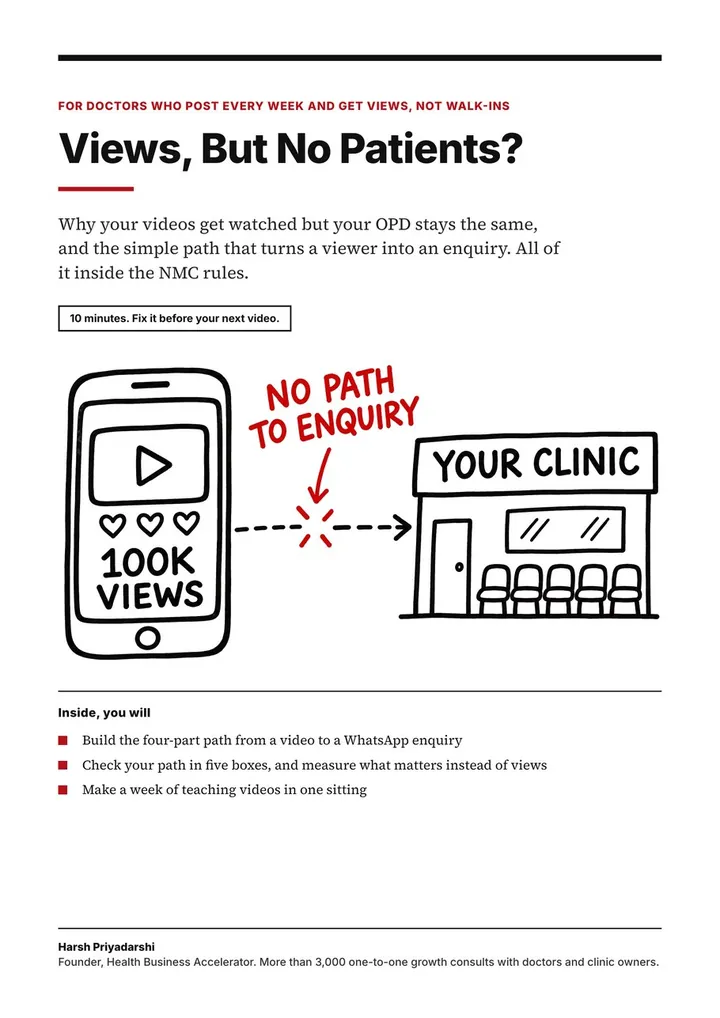
Not from views. A million views with no messages is a nice screenshot, not a busier clinic. Track saves, shares, profile visits, DMs and, most of all, the patients who say "maine aapka video dekha tha" ("I saw your video"). Train your front desk to ask every new enquiry how they found you, and log the answer.
Make the path from viewer to patient easy: a one-line bio saying who you help, a link to a condition page or WhatsApp, highlights that answer top questions, and a comment keyword that triggers an automatic reply. See our gastroenterology page for how we plan content for that speciality, and our Bhopal page for how we work in the city.
The short version
- Own one problem the city can repeat in one sentence.
- Speak plain Hindi on camera, one idea per reel, at least two of educate, emotion and entertain.
- Batch reels in one weekly slot, and build a YouTube library of twenty real questions.
- Give talks in residents' associations, offices and colleges, and record them.
- Count enquiries and "I saw your video", not views.
Frequently asked questions
Should a doctor in Bhopal make reels in Hindi or English?
Mostly Hindi, spoken the way your patients speak, with English words only where patients use them anyway. English reels can work for a small professional audience, but most families respond to a doctor who sounds like they are talking to them, not lecturing. Test both, and keep whatever brings more enquiries.
How long does it take for a doctor's personal brand to bring patients?
Short video usually takes two to three months of consistent weekly posting before patients start mentioning it. A YouTube library often takes three to six months before it compounds. Talks can bring patients within weeks if the follow-up is fast. The doctors who win are the ones who keep going past month three.
Can I build a personal brand without showing patients' faces?
Yes. Most of the strongest doctor content shows the doctor, not patients: explanations, myth versus fact, what happens during a procedure and answers to real questions. If you ever show a patient's face, story or result, get written consent first and protect their privacy. Many doctors never need to.
What if I'm not comfortable on camera?
Start small and batch it. Record in your consultation room, talk to one imagined patient, and use prepared scripts in your own words. Most doctors relax after the first few sessions. If you truly don't want to be on camera, educational videos without the doctor can still help, but your face and voice build trust fastest.
On a free growth call, my team traces your last month from enquiry to treatment and shows you your biggest leak in rupees.