Bengaluru clinics should hire front desk staff for warmth, written WhatsApp skills, persistence and the languages patients use, across Kannada, English, Tamil, Telugu and Hindi. Test with a phone call, a WhatsApp role play and a shadow day. Add a treatment coordinator past twenty consultations a day. Pay incentives on show-ups and started treatments, and use your SOPs and an AI knowledge assistant to train new staff faster.
Hiring for a Bengaluru clinic has a twist most cities do not. Your patients speak five languages between them, half of them would rather type than talk, and they expect the speed of the apps they use all day. The receptionist who was perfect for a clinic ten years ago, warm on the phone and good with walk-ins, now also needs to write clear, kind WhatsApp messages and hand conversations smoothly to colleagues.
The good news is that this city has a lot of people who already do this kind of work in other industries.
What should a Bengaluru clinic hire front desk staff for?
Not for polish or a low salary. For:
- Warmth, heard in a voice and read in a message.
- Written skill. Short, clear, kind WhatsApp replies with no mistakes in names, times or fees.
- Empathy for anxious patients and worried family members.
- Persistence to follow up without sounding pushy.
- Languages. Between your team, cover the languages your patients actually use. Most clinics here need English and Kannada, and many also need Tamil, Telugu or Hindi.
Look beyond clinic experience. People from hospitality, airlines, customer support and banking often bring exactly the service habits and message skills you need. Ask honestly about the commute to your clinic at the hours you need them, because a long daily journey through traffic wears good people down.
How do you test a candidate?
- The phone test. Call before any interview and talk for five minutes. That is how your patients will meet them.
- The WhatsApp test. Send three messages as a patient: "Hi, timings?", "Kitna lagega?" and "Can my mother see the doctor on Saturday? She only speaks Telugu." Judge the replies on warmth, accuracy and whether they move towards a booking.
- The role play. You play a worried caller who only wants the price. The best candidates ask questions and listen. The worst read out information.
- The written task. Give them a confusing reminder message and ask them to rewrite it so a patient would understand it in one read. Clear writing is a daily skill here.
- The shadow day. A paid day at the desk before you decide.
When does a Bengaluru clinic need a treatment coordinator?
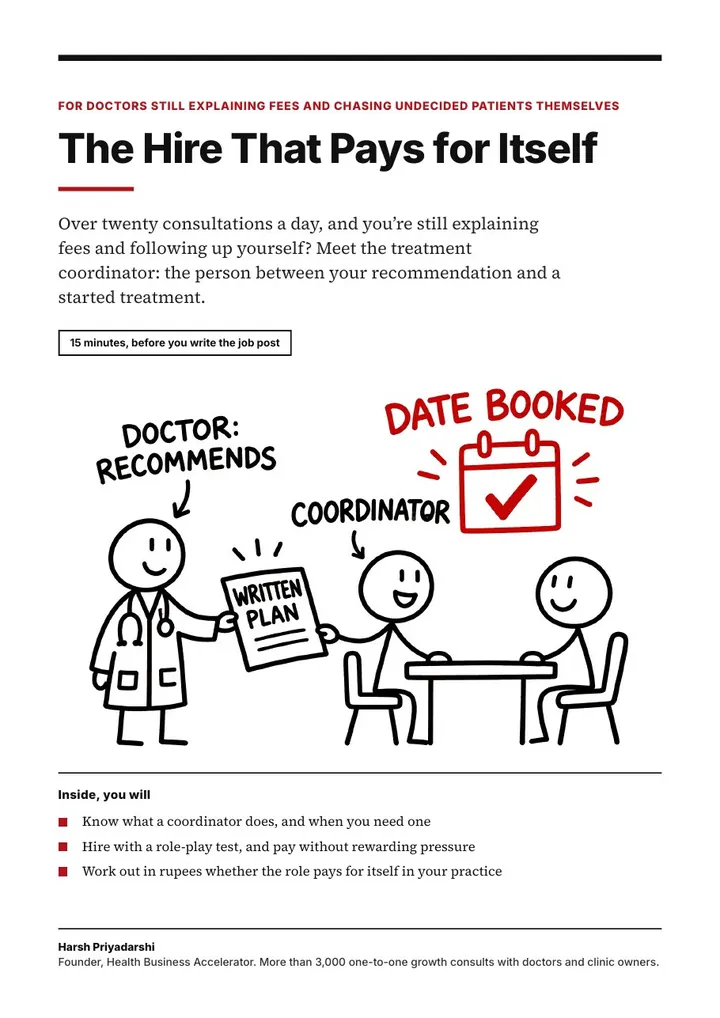
The trigger in my framework is twenty consultations a day. Under that number, a doctor and a well-trained front desk can usually cover the last step between them. Over it, patients start slipping out of the door undecided, and nobody has the time to call them back.
The coordinator walks the patient through the written plan and three options, explains fees, EMI and insurance paperwork, books the date, talks to family members, often by phone or video because they live in another city, and follows up with everyone who did not decide: same day, next day, then days three, seven and fourteen. They negotiate the plan, never the price.
Good coordinators often come from patient counselling roles in hospitals, from nursing, or from service roles that involve money conversations, such as banking and insurance.
How do you train new staff faster?
Write it down first. Turn your SOPs, scripts, fee sheet, plan templates and the twenty questions patients ask most into clear checklists. Then use them three ways:
- In the first week, a new front desk person learns your niche, your doctor, your plans and fees, the five-step script for calls and WhatsApp, and your systems, and reviews good and bad recorded conversations.
- In the first four weeks, a new coordinator learns your core treatments at a patient's level, sits in on consultations, masters every option and payment method, and practises objections in role plays.
- Every day after that, an AI knowledge assistant built only from your approved SOPs and fee sheet answers staff questions like "what do we say if a patient asks about insurance for this?" so they do not have to interrupt the doctor.
Pair that with weekly call and message scoring, and new people become confident in days rather than months. Managers can see exactly who needs help. Our team training work builds these programmes, and our CRM and AI work builds the knowledge assistant.
How should you pay them?
A fair fixed salary plus incentives that reward the right outcome.
| Role | Incentive tied to | Guardrails |
|---|---|---|
| Front desk | Patients who book and actually turn up | Weekly review of calls and WhatsApp threads; no booking people just to hit a number |
| Treatment coordinator | Treatments actually started | Track complaints and refund requests, review conversations weekly, never reward pressure |
Paying the front desk per booking alone sounds sensible and goes wrong quickly: people get booked who were never going to come. Paying on show-ups fixes that. In the same way, a coordinator paid only on revenue may push bigger plans than patients need, so the guardrails matter as much as the incentive.
What does a coordinator add?
Here is an example with illustrative numbers. Say your clinic does 22 consultations a day, six days a week, so 132 a week, and 30% start treatment, about 40 patients. A coordinator who owns the handover, the family calls and the follow-up lifts that to 36%, about 48 patients. At an average plan of ₹40,000, 8 extra patients is ₹3.2 lakh more a week.
How do you keep good people?
Give each person a one-page role card: what they own, the numbers they are measured on, and what a great week looks like. Stagger shifts around the evening and Saturday rush. Show the team the Monday numbers so they see how their work becomes patients. Offer a path from front desk to coordinator to team lead. And make the tools good: a shared inbox, a CRM that does the remembering, and templates that save time. People leave clinics that make simple work feel hard. Our team is based in Whitefield, and our Bengaluru page explains how we work with clinics across the city.
The short version
- Hire for warmth, written WhatsApp skill, persistence and the languages your patients use.
- Test with a phone call, a WhatsApp test, a role play and a shadow day.
- Past twenty consultations a day, hire a coordinator who can involve families in other cities.
- Train from written SOPs, with an AI knowledge assistant and weekly scoring.
- The full system is in Good Doctors Go Broke.
Frequently asked questions
Where can I find good front desk staff for my Bengaluru clinic?
Look beyond clinics. People from hospitality, airlines, customer support and banking often bring the service habits and message skills a modern front desk needs. Ask your team and network for referrals. Whoever you consider, test them with a phone call, three WhatsApp messages and a role play before any formal interview.
Can AI help train my clinic staff?
Yes, if it is built only from your approved SOPs, scripts and fee sheet. An AI knowledge assistant can answer staff questions instantly, and AI call scoring can show managers who needs help. It supports training, it does not replace it. Keep weekly reviews of real conversations and role plays with a person.
How many languages should my Bengaluru clinic staff speak?
Enough to cover the languages your patients actually use, across the team rather than in one person. Log every enquiry's preferred language for a month. Most clinics need English and Kannada, and many need Tamil, Telugu or Hindi too. Build your roster so each common language is covered on most shifts.
What should a treatment coordinator do for patients whose families live elsewhere?
Send the written plan on WhatsApp, with the patient's permission, and offer a short phone or video call with the family members who help decide. Answer their questions calmly, explain options and payment, and book a next step. Many Bengaluru decisions are finalised on that call, so make it easy to schedule.
On a free growth call, my team traces your last month from enquiry to treatment and shows you your biggest leak in rupees.